
The Trump crypto coin is an interesting newcomer in the digital asset market. However, before investing your funds, it’s important to understand the potential risks and the main aspects of this project.
- Thoroughly vet the project before investing.
- Be mindful of the legal nuances of using a public figure’s name.
- Keep all documents for tax reporting.
- Use not only CEX but also DEX to trade tokens.
- Monitor the contract’s technical aspects and its security.
What is TRUMP
Short answer: TRUMP is the designation of a token tied to the image of Donald Trump; in form it can be a memecoin, a utility token, or a governance token.
When to read this section: if you need a quick way to understand whether this is a marketing product or a real project with utility.
If you are looking for a safe asset, don’t rely on the brand alone — ask for the whitepaper and check the contract code.
What this means technically and from a marketing perspective
- Memecoin: rapid marketing launch, minimal utility, high volatility.
- Utility/governance: the token provides access to services or voting; requires a roadmap and real integrations.
- NFT/tokenized content: collections of digital artifacts that may include royalties or event tie-ins.
Unexpected angle (Contrarian Lens)
Legal disputes around the brand often increase media attention; this temporarily boosts demand and liquidity, but damages long-term reputation. Short-term traders sometimes view such events as a signal for speculation, while long-term investors see a red flag.
Technical aspects of the Trump coin and contract checks
Short answer: contract verification and technical parameters mitigate about 70% of the risks; this includes code verification, audits, and LP checks.
When to do a technical check: before your first purchase and after any contract updates.
If you’re not a developer — use audit services and check key indicators (LP lock, renounced owner, mint function).
What to check first
- Contract verification on Etherscan/BscScan: is the code open and does the ABI match?
- Owner/privileged functions: check for the presence of mint, burn, pause, blacklist, transferFrom with restrictions.
- Renounced contract (renounced) — a state where owner rights are sent to the “zero” address; this reduces the risk of changing terms but does not guarantee safety.
- Liquidity Pool (LP) — are LP tokens locked (liquidity lock) and what share do they represent?
- Audits: CertiK, Hacken, PeckShield, Token Sniffer; read the report itself, not just the badge on the site.
Additional technical risks
- Honeypot (honeypot) — a contract that allows buying the token but blocks selling; check by simulating transactions.
- MEV (Maximal Extractable Value) — extraction of value through adversarial or harmful actions on the market that affects trading UX.
- Oracle manipulation — if the token relies on external oracles, their compromise can change price logic.
Quick checklist
- Is the contract verified? (Etherscan/BscScan)
- Is there an audit from an independent firm?
- Is LP locked? What portion of liquidity?
- Are there owner functions? If so — which ones?
- Roadmap and GitHub (if any) — is development active?

Where to buy/sell: CEX vs DEX (comparison + how to buy)
Short answer: the choice between a centralized exchange (CEX) and a decentralized exchange (DEX) depends on availability, KYC, fees, and contract risks.
When to choose a CEX: if the token is listed and you need simplicity and fiat support.
If you have experience with MetaMask and are ready to take on more risk — DEXs provide access to tokens without listings, but require greater caution.
Comparison CEX vs DEX
| Criterion | CEX (centralized exchange) | DEX (AMM, e.g. Uniswap/PancakeSwap) |
|---|---|---|
| Availability | Requires listing, KYC | Anyone can trade via the contract |
| Counterparty security | Custodial risks, but KYC/AML | Contract risks, no KYC |
| Fees | Fixed/depends on exchange | Gas + slippage |
| Liquidity | Can be high if listed | Depends on the LP pool |
| Suitable for | Beginners, fiat on-ramps | Traders, early participants |
Step-by-step guide: how to buy on a DEX
- Install MetaMask or another non-custodial wallet; configure the network (Ethereum/BNB Chain).
- Buy ETH/BNB/USDT on a CEX or via a fiat on-ramp and transfer to your wallet.
- Go to the DEX (Uniswap/PancakeSwap) and paste the token’s official contract.
- Set an acceptable slippage — for memecoins often 5–12% or follow the project’s instructions.
- Do a test swap with a small amount, check the ability to sell (this helps minimize honeypot risk).
- After a successful test transaction — make the main purchase. Lock LP if possible or verify LP lock.
- Keep transactions and screenshots for tax reporting.
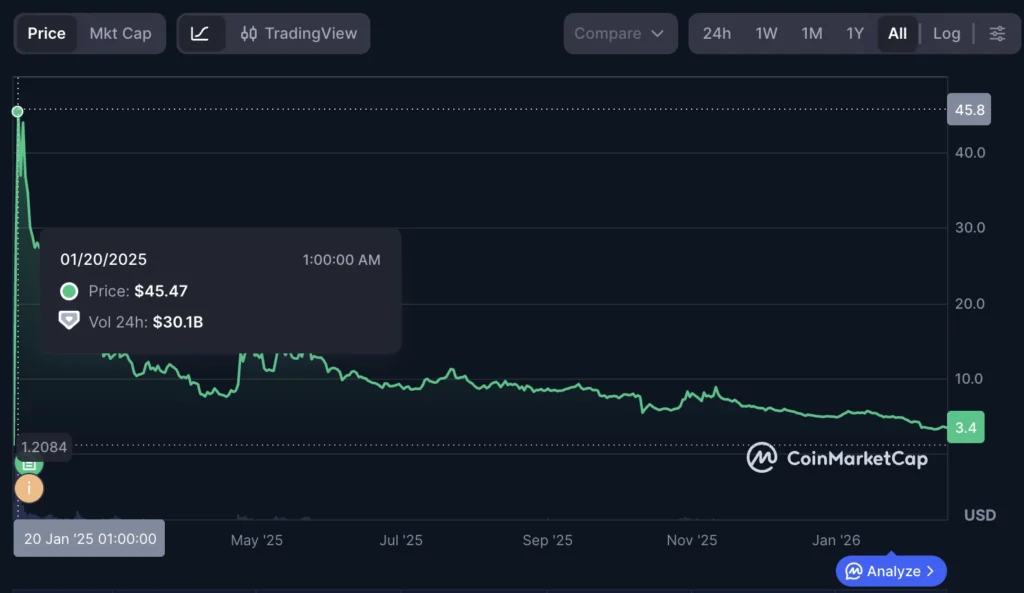
TRUMP Coin Price 2026
We recommend checking the price of Trump Coin on CoinMarketCap, as it is one of the most reliable and popular platforms for tracking cryptocurrency prices in real time. The price is updated automatically based on data from many major exchanges, allowing you to get the most accurate and up-to-date information. In addition, CoinMarketCap provides extra metrics such as market capitalization, trading volume, and historical price performance, which help you better evaluate the overall market situation.
Legal and tax issues
Short answer: using a public figure’s name can create intellectual property risks; in Ukraine, crypto operations must be documented for tax purposes.
When to consult a lawyer: if you plan to launch a project or deal with significant amounts.
If you suspect an intellectual property violation — consult an attorney immediately.
Legal risks
- Trademark and image rights: using a name without permission can lead to lawsuits.
- Sanctions and related persons: if the project is connected to sanctioned individuals, payment gateways and exchanges may block the asset.
- Team liability: anonymous developers increase the risk of lack of accountability.
Taxes in Ukraine — practical tips
- Record all operations: dates, amounts, contracts, the hryvnia equivalent on the date of the operation.
- Consult a tax advisor about taxation of crypto income, tax rates, and declarations.
- When cashing out to fiat — keep exchange documentation.
Main risks and common mistakes (and how to fix them)
Short answer: the main threats are financial volatility, technical backdoors in the contract, and legal claims; mistakes often stem from insufficient due diligence.
When to act: check the checklist before every investment; if in doubt — don’t invest.
If you’re already in trouble — document transactions and turn to the community or a lawyer.
Common mistakes and how to fix them
- Mistake: Buying out of FOMO. How to fix: keep an entry/exit plan; use test transactions.
- Mistake: Not checking the contract. How to fix: use Etherscan/BscScan, Token Sniffer, and read audits.
- Mistake: Ignoring LP lock. How to fix: check whether LP tokens are locked; if not — treat as higher risk.
- Mistake: Trusting the official site without verification. How to fix: verify social accounts, GitHub, and developers’ names.
- Mistake: Not accounting for taxes. How to fix: keep all documents and consult a tax advisor.
- Mistake: Using an insecure wallet for large sums. How to fix: move assets to a hardware wallet.
Advice for users in Ukraine
Short answer: adhere to due diligence, use hardware wallets for large sums, and keep documentation for tax authorities.
When this is critical: when buying large token packages or dealing with unfamiliar projects.
If you plan to trade frequently — set up an Excel/tool to record operations and keep screenshots.
Short checklist
- Check the contract on Etherscan/BscScan.
- Find the audit and read its conclusions.
- Check LP lock and the presence of vesting for the team.
- Use a test transaction.
- Keep all confirmations for taxes.
- Use reputable CEXs or DEXs with a track record.
Forecast
Short answer: the forecast depends on regulation, audits, community activity, and legal proceedings; without these components long-term value is doubtful.
When the forecast will be positive: the project has passed an audit, has partners, and locked liquidity.
If you see lawsuits over the name — expect short-term volatility and delisting risk.
Scenarios (no specific numbers)
- Conservative: no audit or a negative one — the token is likely to remain a speculative asset and disappear after a pump-and-dump.
- Moderate: a positive audit, part of LP locked, active team — the token may exist as a niche utility or meme.
- Optimistic: listings on CEXs, partnerships, legal permission to use the image — a chance for longer existence and increased utility.
Counterintuitive thought
Often the loudest emotional price swings come not from fundamentals but from legal scandals. This means: in the short term a lawsuit can raise the price; in the long term it can destroy the project.
Signals to 2026
Short answer: until 2026, track listings on major exchanges, audits, LP locking, public partnerships, and legal actions.
When this matters: if you plan to hold a position for more than a year.
If you see increased social activity without rising liquidity — that’s a red flag.
What to track specifically to 2026
- Listings on Binance/Coinbase/FTX-like CEXs — they provide scale.
- Audits by CertiK/Hacken — increase trust.
- Public partnerships with well-known companies or funds.
- Legal claims regarding use of the name/brand.
- Growth in liquidity (LP) and long-term vesting schedules for team/investors.
Indicators that may signal failure
- No audit or reports showing critical vulnerabilities.
- A large share of token supply held by anonymous wallets without vesting.
- Blocking sales for ordinary users (honeypot).
Mini-glossary
Tokenomics
Brief: a set of rules that define issuance, distribution, and incentives of a token; determines long-term economics.
Renounced contract
Brief: a state where the owner’s rights to a smart contract are renounced or sent to a zero address; reduces the risk of owner changing the code.
LP lock (liquidity lock)
Brief: a mechanism where LP tokens are locked for a defined period, reducing the risk of a rug pull.
Honeypot
Brief: a fraudulent contract that allows buying a token but blocks selling.
MEV (Maximal Extractable Value)
Brief: additional value that can be extracted by malicious or optimizing transactions by miners/block validators.
Oracle manipulation
Brief: an attack on oracles (external price sources) that changes the internal logic of contracts and can lead to losses.
Vesting
Brief: a schedule for unlocking tokens for the team or investors; important for trust.
FAQ
1. Is it legal to create a token using a public figure’s name?
In many jurisdictions, using a name or likeness without permission can lead to intellectual property claims; legal consultation is mandatory.
2. How to check that a TRUMP token is not a honeypot?
Do a test buy of a small amount and try to sell; check contract functions for blocked transfer/approve logic and use Token Sniffer.
3. What is LP lock and why is it important?
LP lock is the locking of LP tokens in a smart contract; it reduces the risk of a rug pull because creators find it harder to remove liquidity.
4. Do I need to pay taxes on trading such tokens in Ukraine?
Yes, crypto asset operations can be taxable; keep all transaction records and consult a tax advisor.
5. How to trust an audit?
Check the full audit report, who performed it, whether there are critical findings, and if they were fixed; a badge on a website is not always proof.
6. What to do if the contract has owner functions?
Assess the risk: find out exactly which functions the owner has; if these include mint/blacklist/pause — the risk is significant.
7. Which tools are recommended for contract checks?
Etherscan/BscScan for code verification, Token Sniffer, Rug Check, CertiK/Hacken for audits, CoinGecko/CoinMarketCap for listings.
8. How to store proof of operations for the tax office?
Keep CSV transaction files from wallets, screenshots of orders, transfer confirmations, and exchange invoices.
9. Should I wait for a CEX listing before selling?
A CEX listing increases liquidity but does not guarantee absence of risks; check a combination of signals, don’t rely solely on listing.
10. What are red flags on social media?
Anonymous team accounts, aggressive promises of “guaranteed profit”, lack of specifics in the roadmap and no verified partners.
The Trump crypto coin can be either a short-term meme opportunity or a legally risky trap. Make decisions based on technical due diligence, verified audits, locked liquidity, and a clear legal position. Keep records for taxation, use hardware wallets for large amounts, and perform test transactions. If in doubt — consult a lawyer or tax advisor before acting.
If you found this article useful — share it or leave a comment with questions: I will reply in detail.