
What are Crypto Faucets?
Crypto faucets are websites, mobile apps or bots that give away small amounts of cryptocurrency for free in exchange for simple tasks: solving CAPTCHAs, watching ads, playing mini-games or filling out surveys. The model appeared in 2010 as a tool to popularize Bitcoin among a wide audience. Today crypto faucets cover dozens of different coins and tokens, although the basic principle remains the same — exchanging a user’s time and attention for micro-rewards in cryptocurrency.
The topic is relevant for Ukrainian users who encounter digital assets for the first time and are looking for a free way to get initial experience with crypto wallets and transactions. At the same time the information space is full of exaggerated promises, and sober analysis helps distinguish real opportunities from traps.
Key:
- A crypto faucet pays micro-shares of cryptocurrency, most often satoshis (1 satoshi = 0.00000001 BTC), for simple actions with a fixed claim interval — from 5 to 60 minutes.
- The main source of revenue for the operator is ad impressions, affiliate commissions or promoting their own token. The user “pays” with their time and attention.
- Real financial benefit from faucets is usually minimal: the equivalent of a few cents to a few dozen cents per hour of active work.
- Risks include fraud, phishing, installing malicious software and losing accumulated funds if the platform shuts down.
- Withdrawals are possible only after reaching the withdrawal threshold, and network fees can eat a significant portion of earnings.
- Alternatives — airdrops, testnet campaigns, staking — often give higher returns for comparable time investment.
Find a Safe Crypto ExchangeChoose a trusted crypto exchanger in your city
Definition in simple words: from Bitcoin faucets to multi-currency platforms
Imagine a tap that drips water. Bitcoin faucets work by the same metaphor: instead of water, cryptocurrency “drips”, and each drop is a few satoshis. The term “faucet” comes from this metaphor.
Brief history
The first known Bitcoin faucet was created by Gavin Andresen in 2010. The service gave away 5 BTC per visit — at the time that amount was worth fractions of a cent. The goal was purely educational: to show people what a Bitcoin transaction is. Over the years BTC’s value rose, payouts were reduced to micro-shares, and monetization shifted toward aggressive advertising. Parallel to that, faucets for Ethereum, Litecoin, Dogecoin and other coins appeared, as well as multi-currency platforms.
Why it still exists
Operators earn more from advertising and affiliate programs than they pay out to users. As long as that difference remains positive, the model is economically viable. For a user, a faucet is a way to get first crypto experience without financial investment. For projects launching new tokens, faucets act as a marketing tool.
How crypto faucets work in practice
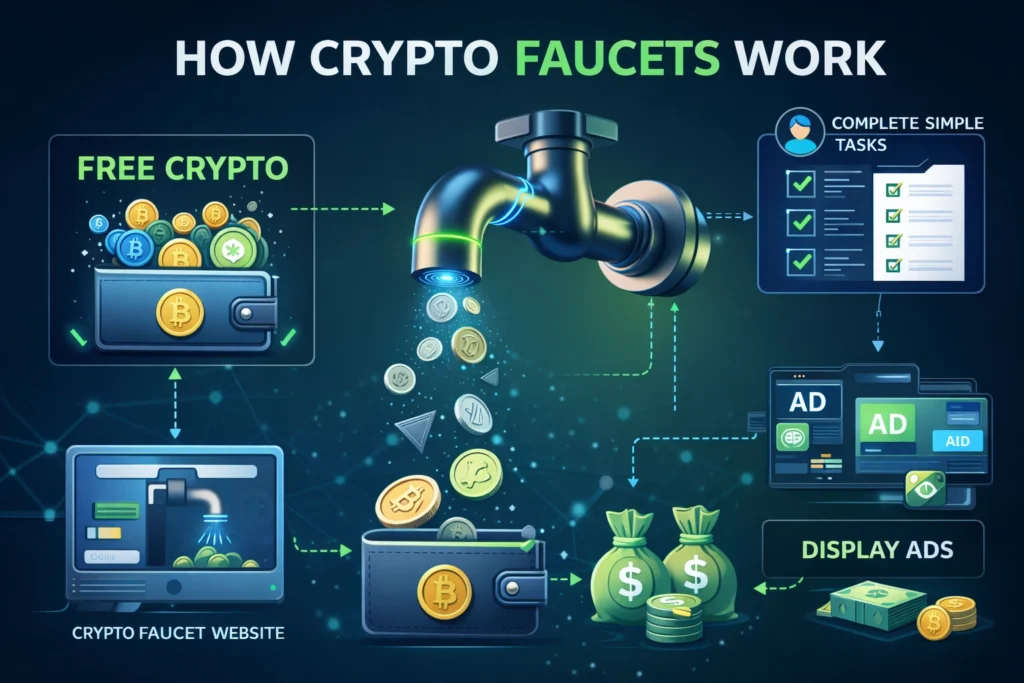
The mechanics of most faucets are the same: a user registers, completes tasks, receives credits to an internal balance and withdraws funds after reaching a minimum amount.
Operator revenue sources
Ad networks are the primary source. Every banner view, video or solved CAPTCHA generates revenue for the site owner. A second stream is referral commissions from exchanges and wallets to which the operator directs traffic. Some projects use browser mining: a script leverages the visitor’s device computing resources, which creates extra load and a security risk.
What the user does
Typical actions are solving CAPTCHAs, watching 15–30 second ad videos, participating in mini-games (e.g. lottery or dice), completing surveys and registering on partner platforms. Some faucets offer “multiplayers” — game mechanics where you can increase or lose what you earned. These are de facto micro-casinos and should be treated accordingly.
How it works: a short process
- Register on the platform: usually an email or a crypto wallet address is required.
- Choose a task: CAPTCHA, ad video, game, survey.
- Perform the action and receive credit: the system logs the result and adds a micro-reward to the internal balance.
- Wait for the claim interval: a timer blocks repeat claims for a set period — from 5 to 60 minutes.
- Repeat the cycle: steps 2–4 are repeated until the withdrawal threshold is reached.
- Request withdrawal: the user provides an external wallet address and confirms the operation.
- Transaction processing: the operator creates a batch transaction to reduce network fees.
- Funds credited to the wallet: depending on the network and congestion — from a few minutes to several hours.
Types of faucets and who uses them
Web faucets
The classic format — a regular website with a “Claim” button. The most common type, accessible from any browser.
Mobile apps
Apps for Android and iOS that often combine a faucet with game mechanics. The risk is higher: an app may request excessive permissions or contain hidden scripts.
Messenger bots
Telegram and Discord bots act as simplified faucets. Convenient, but rarely have transparent payout policies. If you use bots, always check the project’s history and reviews in independent communities.
Token faucets and airdrop platforms
Some blockchain projects create faucets to distribute their own tokens. This is closer to marketing airdrops than classic faucets. For businesses that need to attract an initial audience, this model can be more effective than direct advertising.
Risks, limitations and trade-offs
Crypto faucets are often presented as “free money”. In reality the user pays with time, attention and potentially — security.
Fraud and unreliability
A large share of faucets disappear after collecting ad revenue without paying out. Telling a reliable service from a one-day site is difficult: payout screenshots are easy to fake.
Phishing and malware
Fake faucets ask for seed phrases or private keys under the guise of “wallet verification”. No legitimate service ever requests this. Sites with browser mining can overload the CPU and shorten a device’s lifespan.
Economic inefficiency
The average payout per action on a typical faucet is from 1 to 50 satoshis. At 2024–2025 rates this equals a fraction of a cent. Network fees on Bitcoin can exceed the accumulated amount, making withdrawal pointless.
When to choose a faucet over other options
The only rational scenario is learning. If you need to understand how a crypto wallet and a blockchain transaction work, a faucet provides a free “sandbox”. As a source of real income it almost always loses to alternatives.
Comparison with alternatives
| Crypto faucet | Airdrop | Testnet campaign |
|---|---|---|
| Principle: Micro-payouts for simple actions | One-time token distribution for meeting conditions | Testing a new blockchain for possible reward |
| Typical reward: Fractions of a cent per session | From a few to hundreds of dollars (not guaranteed) | Potentially significant (not guaranteed) |
| Time cost: Continuous, low return | One-off, medium return | Moderate, possible high return |
| Risks: Fraud, ads, malware | Fake airdrops, phishing | Complexity, no guarantee of payout |
| Suitable for: Beginners for learning | Experienced users with active wallets | Technically prepared enthusiasts |
Common mistakes and myths
Myth 1:
“You can earn real money from faucets without effort.”
Reality: the typical hourly “rate” on a faucet is the equivalent of a few cents. Time almost always costs more.
Myth 2:
“Bitcoin faucets give away coins for free because it’s charity.”
Reality: operators earn far more from ads than they pay out. It’s a business model, not philanthropy.
Myth 3:
“If a faucet asks for a seed phrase, it’s for verification.”
Reality: that’s phishing. No legitimate service requires your seed phrase.
Myth 4:
“A referral program with 50% commission is a sign of a profitable faucet.”
Reality: inflated referral rates often signal a pyramid scheme or that the base payout is negligible.
Myth 5:
“Faucets are completely safe because they don’t require a deposit.”
Reality: risk is not only financial. Collection of personal data, IP addresses, installing malware — these are real threats even when you invest nothing.
Myth 6:
“One faucet is enough for steady accumulation.”
Reality: even users of multiple faucets rarely reach the withdrawal threshold within a reasonable time.
Legal and tax aspects in Ukraine
Legislation regarding the circulation of virtual assets in Ukraine is still being formed. The “On Virtual Assets” law creates a basic legal framework, but subordinate acts and tax practice are still developing.
Formally any receipt of cryptocurrency can be considered income subject to declaration. If you actively use faucets, keep records: dates, amounts, transaction addresses. Consult a tax specialist about current requirements — rules can change faster than online articles are updated.
Practical checklist before starting
- Check the faucet’s reputation: look for independent reviews, domain registration date, community activity.
- Create a separate non-custodial wallet exclusively for micro-payouts.
- Never enter your seed phrase or private key on third-party sites.
- Make a test withdrawal of the minimum amount before active use.
- Compare the withdrawal threshold with the network fee — make sure the payout makes economic sense.
- Update your operating system and install antivirus software.
- Check mobile app permissions: camera, microphone, file access — these are unnecessary for a faucet.
- Assess the opportunity cost of your time: an airdrop or testnet campaign may yield more.
- Keep records of all receipts for possible tax reporting.
- Don’t trust promises of guaranteed high income — it’s a red flag for fraud.
Key terms
Satoshi
The smallest unit of Bitcoin. One satoshi equals 0.00000001 BTC. Most Bitcoin faucet payouts are measured in satoshis.
Claim interval (claim interval)
The fixed period of time between two consecutive reward claims. A typical interval is from 5 to 60 minutes.
Withdrawal threshold
The minimum amount that must be accumulated on the internal balance to request a transfer to an external wallet.
Custodial wallet
A wallet whose private keys are held by a third party (exchange, service). Convenient, but the user does not have full control over the funds.
Non-custodial wallet
A wallet where private keys are stored exclusively by the owner. Provides full control but requires responsible key storage.
Seed phrase
A set of 12 or 24 words used to recover access to a non-custodial wallet. Disclosing the seed phrase means losing control over assets.
Browser mining
Using a visitor’s device computing resources to mine cryptocurrency via a JavaScript script. Often started without the user’s explicit consent.
Batch transaction
Combining several payouts into a single blockchain transaction. Faucet operators use this method to reduce total network fees.
Additional questions
Can you really get cryptocurrency from a faucet for free?
Yes, but “free” is conditional. You spend time and attention watching ads. The actual value received is usually lower than minimum wage in any country. A faucet should be seen as an educational tool, not a source of income.
How much can you earn from Bitcoin faucets per month?
The exact amount depends on BTC price, faucet generosity and time spent. Rough estimates suggest an active user of a single faucet can accumulate the equivalent of $0.10 to $2 per month. Withdrawal fees often exceed this amount.
How to tell a reliable faucet from a fraudulent one?
Pay attention to domain age, public information about the team, real reviews on independent forums and transparent payout terms. If a service promises disproportionate amounts or requires prepayment — it’s fraud.
Do you need to pay taxes on income from crypto faucets in Ukraine?
Formally receiving cryptocurrency may be classified as income. Exact rules depend on current legislation at the time of receipt. It’s recommended to record all transactions and consult a tax specialist.
Is it safe to use Telegram bots to receive cryptocurrency?
Security depends on the specific bot. Check official project channels, the quantity and quality of reviews, and whether the bot asks for unnecessary data. Never share your seed phrase via messenger.
Which cryptocurrency is most often distributed through faucets?
Bitcoin remains the most popular, but Ethereum, Litecoin, Dogecoin, Tron and tokens of new projects are also common. Choice depends on network fees: faucets on low-fee networks (Tron, Solana) allow withdrawing smaller amounts.
Are there legal alternatives to faucets for getting your first cryptocurrency?
Yes. Airdrops from new projects, participating in testnet campaigns, educational programs on large exchanges (“learn and earn”) and crypto cashback are common and often more rewarding options.
Can you use a VPN to access faucets?
Technically — yes, but many platforms forbid VPNs in their terms of use. Violating rules can lead to account blocking and loss of accumulated funds. Check the specific service’s terms before connecting via VPN.