
What is USD1?
USD1 is a stablecoin pegged to the US dollar at a 1:1 ratio, issued by World Liberty Financial, a company associated with the family of Donald Trump. The token is positioned as a fiat-backed digital asset, with reserves consisting of short-term US Treasury bills, dollar deposits, and other highly liquid instruments. The USD1 coin is deployed on the Ethereum and BNB Chain blockchains as ERC-20 and BEP-20 tokens, respectively.
The topic is timely because the emergence of a stablecoin with a direct link to the sitting US president creates an unprecedented situation at the intersection of the crypto industry and politics. For Ukrainian users, this means additional layers of risk that extend far beyond the usual assessment of digital assets.
- The USD1 stablecoin was issued by World Liberty Financial (WLFI), whose co-founders include members of the Trump family — Donald Trump Jr. and Eric Trump.
- The token is backed by US Treasury bills and dollar deposits; custodial services are provided by BitGo.
- As of mid-2025 USD1 has a market capitalization of over $2 billion, but its circulation is concentrated mainly on decentralized platforms.
- The project lacks a full independent audit of reserves from recognized international auditing firms, which is a significant red flag.
- The regulatory status of the token remains uncertain in the US and in most other jurisdictions, including Ukraine.
- The name USD1 may be used by other unrelated projects on different blockchains — before any interaction you should verify the smart contract address.
Find a Safe Crypto ExchangeChoose a trusted crypto exchanger in your city
What “USD1” can mean: ticker, stablecoin or branded token
The USD1 ticker is not a unique identifier. Different projects on different blockchains can issue tokens with the same name, and there is not necessarily any connection between them.
Stablecoin from World Liberty Financial
The best-known token under this ticker is the product of World Liberty Financial. This is usually what is meant when people refer to Trump’s USD1 coin (he also has a Trump cryptocurrency). The project was announced in March 2025, and the public launch took place in May of the same year.
Possible fakes and clones
Impostor tokens named USD1 or similar variations regularly appear on decentralized exchanges. They have no connection to the original project. Before buying, always verify the smart contract address via blockchain explorers — Etherscan for Ethereum or BscScan for BNB Chain — against the information published on the official World Liberty Financial website.
Generic designation vs. specific token
The phrase “USD 1” or “1 USD” is sometimes used simply to denote one US dollar. In the crypto context this can create confusion. If you come across an offer to buy “USD1” — clarify which specific asset is being referred to.
How the peg to the dollar works
Stablecoins maintain parity with fiat currency through various mechanisms. USD1 uses a full fiat-backed model. This means that for every issued token there is theoretically an equivalent in dollar-denominated assets.
USD1 fiat backing
According to the issuer, reserves consist of short-term US Treasury bills (T-bills), dollar bank deposits and cash equivalents. The custodian, i.e., the keeper of reserve assets, is BitGo — a well-known institutional custodial service.
Difference from algorithmic stablecoins
Unlike algorithmic models such as the former UST from Terra, USD1 does not rely on mathematical protocols to maintain its price. After UST’s collapse in 2022, when investors lost tens of billions of dollars, fiat-backed models are considered more conservative. However, they only work if the claimed reserves actually exist and are regularly independently verified.
Transparency issues
As of mid-2025 World Liberty Financial has not published full audit reports from independent Big Four-level firms. The company points to custodial reporting from BitGo, but that does not replace an independent audit of reserves. For comparison: USDC issuer Circle publishes monthly attestation reports from Deloitte.
How it works: a short process
- Issuer World Liberty Financial forms a reserve in dollar assets — Treasury bills and bank deposits.
- Based on this reserve, USD1 tokens are issued (minted) on the Ethereum and BNB Chain blockchains.
- Custodian BitGo holds the reserve assets and confirms their existence.
- Tokens enter circulation through authorized partners and decentralized platforms.
- A user buys USD1 on an exchange or DEX, receiving a token that the issuer claims equals one dollar.
- Upon redemption an authorized participant returns tokens to the issuer and receives dollars from the reserve in return.
- Tokens returned to the issuer are burned, reducing the total supply in circulation.
- The open market price is kept around $1 thanks to arbitrage between the market price and the guaranteed redemption price.
Who is behind the project and why it matters
World Liberty Financial was founded in 2024. Key figures include Donald Trump Jr. and Eric Trump. Donald Trump himself is listed as the project’s “chief crypto advocate” — a marketing role rather than an operational position.
Political context
The connection of the stablecoin with the sitting US president has sparked intense debate. Critics, including some US lawmakers, point to a conflict of interest: the president can simultaneously influence regulatory policy on crypto assets while profiting financially from their issuance. This factor could affect the token’s regulatory fate.
Team and governance
Operational management is carried out by Zack Folkman and Chase Herro, who had experience in the crypto industry before founding WLFI. The full governance structure has not been disclosed publicly to the extent that is standard for major stablecoin issuers.
Large deal with MGX
In May 2025 the Abu Dhabi investment fund MGX used USD1 to pay for a $2 billion investment in the crypto exchange Binance. This transaction sharply increased the token’s market capitalization but also intensified the debate about potential conflicts of interest.
Risks, limitations and trade-offs
Any stablecoin carries risks. In the case of USD1 they are amplified by several unique factors.
Lack of a full audit
The key risk is the absence of an independent audit of reserves. Without it, it is impossible to confirm that each token is truly backed by dollar equivalents. If you are dealing with large sums, this factor should be decisive.
Regulatory uncertainty
There is still no federal law on stablecoins in the US. The GENIUS Act bill, which was intended to regulate the market, has faced delays largely because of debates around USD1’s connection to the president’s family. In Ukraine virtual assets are regulated, but there are no specific rules regarding foreign stablecoins with a political background.
Risk of depeg and liquidity
Low liquidity on secondary markets can lead to a temporary loss of peg. You should choose another stablecoin in situations where instant conversion to fiat via centralized exchanges with high liquidity is critical.
Counterparty and political risk
Changes in the political situation in the US — for example, the outcome of subsequent elections or sanction decisions — could directly affect the project’s fate. This is a risk that politically neutral stablecoin issuers do not have.
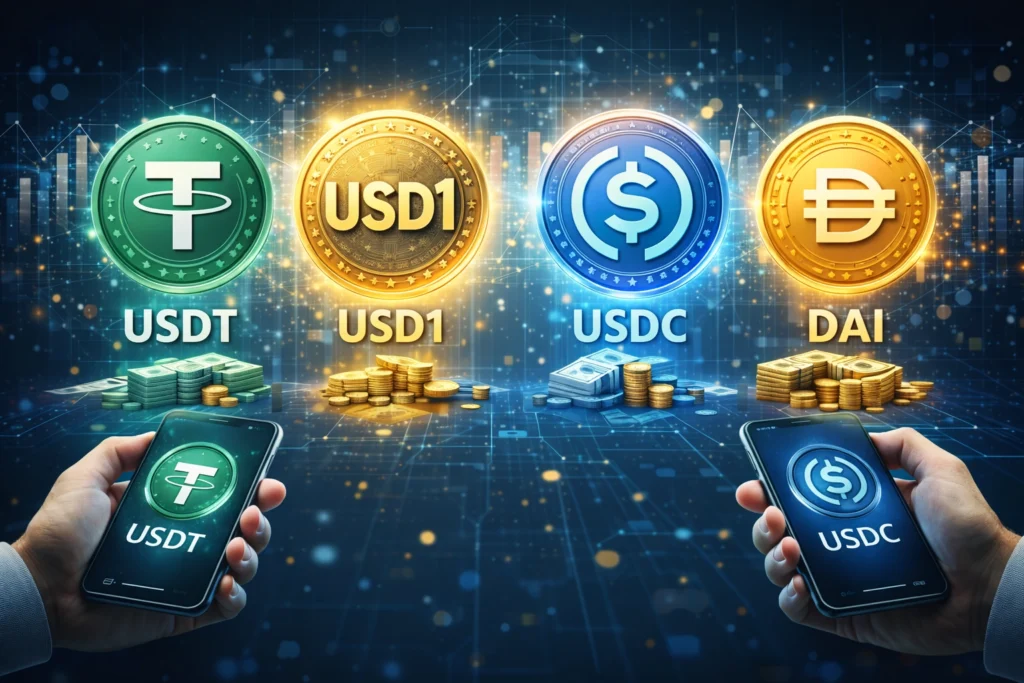
Comparison with alternative stablecoins
| Parameter | USD1 | USDT (Tether) | USDC (Circle) |
|---|---|---|---|
| Type of backing | Fiat (T-bills, deposits) | Fiat (T-bills, commercial paper) | Fiat (T-bills, deposits) |
| Independent audit | Absent (BitGo custodial reporting) | Quarterly attestations by BDO Italy | Monthly attestations from Deloitte |
| Blockchains | Ethereum, BNB Chain | 15+ blockchains | 16+ blockchains |
| Market capitalization (mid-2025) | ~$2.1B | ~$150B | ~$60B |
| Liquidity | Limited, mostly DEX | Highest in the segment | High |
| Regulatory status | Uncertain | Partial licenses in several jurisdictions | Licenses in the US and EU |
| Political connection | Trump family | None | None |
| Who it’s suitable for | Experienced users who understand the specific risks | Traders who need maximum liquidity | For businesses that require regulatory transparency and compliance |
Common mistakes and myths
“USD1 is the official digital currency of the US government.” No. It is a private token of a commercial company. It has no relation to the Federal Reserve or government digital currencies (CBDCs).
“Because it’s a stablecoin, it will always be worth exactly $1.” Stablecoins can lose their peg. Even USDT and USDC experienced short deviations from parity during market crises.
“Trump personally guarantees the token’s value.” A public figure associated with the project does not provide personal financial guarantees. A marketing affiliation is not a legal liability.
“If a token is on CoinMarketCap, it’s safe.” Aggregators only display exchange data. A listing on an aggregator is not a certificate of safety or asset quality.
“Buying USD1 is an investment that will make a profit.” A stablecoin by design is not an investment instrument for price appreciation. Its purpose is to maintain parity with the dollar. If you are offered to “earn” from the rising price of a stablecoin, that’s a sign of fraud.
“Any token named USD1 is the same product.” There can be dozens of tokens with the same ticker on different blockchains. Always verify the smart contract address.
“Custodial storage replaces an audit.” BitGo confirms custody of assets but does not perform an independent assessment of whether reserves are sufficient to cover all issued tokens.
Practical tips for Ukrainian users
If you work with crypto assets in Ukraine, take into account several important points.
Before buying
Find the official smart contract address on the World Liberty Financial website. Verify it on Etherscan or BscScan. Compare the data with information on CoinGecko and CoinMarketCap. Make sure the contract is verified, and review its functions — the presence of pause or blacklist functions means the issuer can freeze your funds.
Where to buy and how to store
Prefer reputable centralized exchanges with KYC procedures. For long-term storage transfer tokens to a hardware wallet. Keep your seed phrase offline; never enter it on websites or in messengers.
Taxes and reporting
Income from transactions with virtual assets in Ukraine is subject to taxation. Record every transaction: date, amount, exchange rate, wallet addresses. Consult a tax advisor to determine specific obligations — legislation is actively changing.
Actions if you suspect fraud
Keep transaction hashes, screenshots, and messages. Contact the Ukrainian cyber police and the support service of the exchange used for the operation. Report the suspicious token to the administrators of aggregators and blockchain researchers.
Key terms
Stablecoin
A cryptocurrency token whose value is pegged to a stable asset — most often a fiat currency. The aim is to minimize price volatility.
Depeg (depeg)
A situation when the market price of a stablecoin deviates from its stated peg. It can last minutes or weeks depending on the cause.
Custodian
A company that professionally safekeeps assets on behalf of clients. In the context of stablecoins — the keeper of reserve funds.
Smart contract
Program code deployed on a blockchain that automatically executes specified conditions. It defines rules for token issuance, transfer and destruction.
Proof-of-reserves
A procedure for independently confirming that the issuer actually holds assets in an amount sufficient to cover all issued tokens.
Minting (creation of new tokens)
The process of creating new tokens. In the context of stablecoins it occurs when new fiat backing is received.
Burn (token burning)
Destruction of tokens by sending them to an unspendable address. Reduces the total number of tokens in circulation.
KYC (Know Your Customer)
The client identification procedure required for regulated financial services. Includes verification of documents and sources of funds.
Rug pull
A type of fraud in which a project’s developers suddenly withdraw liquidity or user funds, leaving investors with devalued tokens.
Additional questions
Is USD1 an official product of Donald Trump?
USD1 is issued by World Liberty Financial, whose co-founders include members of the Trump family. Donald Trump is listed in marketing materials as the “chief crypto advocate”. This is a commercial project of a private company, not a government or presidential product.
How to check if the USD1 token I’m buying is genuine?
Take the official smart contract address from the World Liberty Financial website. Enter it into Etherscan or BscScan. Compare it with the data on aggregators CoinGecko and CoinMarketCap. If the addresses do not match — it’s a fake.
Can USD1 be exchanged for hryvnia in Ukraine?
There are no direct USD1/UAH trading pairs on major exchanges as of mid-2025. A typical route: convert USD1 to USDT or USDC, then exchange to hryvnia via P2P services or licensed exchangers.
Is it safe to keep savings in USD1?
For storing significant sums in stablecoins choose issuers with confirmed independent audits, high liquidity and a clear regulatory status. USD1 does not yet fully meet these criteria. Diversify funds across several assets.
What are the tax consequences of USD1 transactions in Ukraine?
Transactions with virtual assets are subject to taxation under current legislation. Specific rates and the declaration procedure depend on the type of operation and your tax status. Consult a qualified tax advisor.
Can the price of USD1 fall below the dollar?
Yes. Any stablecoin can temporarily or persistently lose its peg. Reasons include reserve issues, market panic, regulatory restrictions, and technical failures. A fiat-backed model reduces this risk but does not eliminate it entirely.
How does USD1 differ from Trump-related memecoins?
USD1 is a stablecoin with claimed fiat backing. Memecoins like TRUMP have no backing and trade purely on speculative demand. These are fundamentally different asset categories with different risk profiles.
What to do if USD1 loses its peg to the dollar?
Don’t panic and do not sell at any price in the first minutes. Check the issuer’s official channels for explanations. Assess the depth and cause of the deviation. If the depeg is caused by fundamental reserve problems — withdraw funds via available channels as quickly as possible.