
Why did Bitcoin crash
The cryptocurrency market is volatile again. Investors are watching charts and asking: why did Bitcoin crash this time — and is this the start of a prolonged downturn or just another correction before growth resumes. Every significant BTC drop sparks headlines like “Bitcoin is dead,” which have appeared regularly in the media since 2011 — and have proved premature each time. Still, behind every crash are concrete causes: macroeconomic, regulatory, technical and psychological. Understanding them means seeing the market more clearly than a panic headline allows.
This is general information and not financial advice.
The Bitcoin price dropped today not because of a single event. Declines are always the result of several overlapping factors that amplify each other. Below is a detailed breakdown of the mechanisms behind BTC declines, practical steps for Ukrainian users and answers to common questions.
TL;DR
- BTC drops are usually caused by several factors at once: macroeconomics, regulatory actions, derivatives liquidations, on-chain signals.
- Headlines like “Bitcoin is dead” have appeared over 470 times since 2010 — never has that proven true.
- Mass liquidations of margin positions accelerate and deepen crashes.
- An inflow of BTC to exchanges is an early signal of potential selling pressure.
- For Ukrainian users, additional risks come from hryvnia fluctuations, banking restrictions and unreliable exchangers.
- Panic selling during a crash more often locks in losses than protects capital.
Macroeconomic reasons for BTC declines
Bitcoin does not exist in a vacuum. It reacts to the same forces that move stock markets, currencies and bonds.
Decisions by the US Federal Reserve on interest rates directly affect investors’ appetite for risk assets. When the Fed raises rates or signals tighter monetary policy, capital shifts from risky assets (tech stocks, cryptocurrencies) into fixed-income instruments — bonds and deposits.
Find a Safe Crypto ExchangeChoose a trusted crypto exchanger in your city
Inflation figures, GDP data, unemployment rates — all shape market expectations. If inflation comes in higher than forecast, the market prices in a tougher Fed stance, and Bitcoin fell along with the Nasdaq index. BTC’s correlation with tech stocks during risk-off periods remains statistically significant, although it weakens at other times.
Dollar strength
The US Dollar Index (DXY) and BTC price often move in opposite directions. A stronger dollar means investors seek safety, which reduces demand for speculative instruments. For Ukrainian users it’s a double hit: BTC falls in dollars while the dollar strengthens against the hryvnia.
Global liquidity
Central bank balance sheet reductions and declining global liquidity create an environment where risky assets struggle to rise. The amount of money in the system is one of the strongest long-term drivers of cryptocurrency prices.
Regulatory and legal triggers
A single regulator’s statement can crash the market in minutes. Regulatory risk remains one of the key drivers of volatility.
Actions by the US Securities and Exchange Commission (SEC) — lawsuits against exchanges, classification of tokens as securities, denials of ETF approvals — have repeatedly caused sharp price drops. The SEC lawsuit against Binance in June 2023 triggered a 5% BTC decline within hours.
Bans and restrictions in other jurisdictions
China’s mining ban in 2021 crashed the network hashrate and price simultaneously. New exchange requirements in the EU, South Korea or India also create pressure. The market reacts less to the ban itself than to the uncertainty it creates.
Bankruptcies and intermediary failures
The collapse of FTX in November 2022, Celsius bankruptcy, Terra/LUNA crash — these are examples of events where one player’s problems triggered a chain reaction of distrust. Each such event raises questions about counterparty risk in the crypto industry anew.
The role of derivatives and margin liquidations
Margin trading is the most powerful accelerant of crashes. Leverage can turn a moderate correction into a cascade of liquidations.
When the price falls to a margin-call level, the exchange automatically closes a trader’s position. This creates additional selling pressure, pushing the price lower and liquidating the next layer of positions. According to CoinGlass and Coinalyze, during sharp drops daily liquidations of long positions can exceed a billion dollars.
Funding rate as an indicator
The funding rate on perpetual futures shows the balance between longs and shorts. An extremely positive funding rate means the market is overloaded with longs — and any price drop triggers a wave of liquidations. A negative funding rate, conversely, can signal excessive pessimism.
Open interest
Rising open interest while price increases is a sign of a healthy trend. But if open interest grows while price stagnates — that’s an accumulation of risk that can discharge in a sharp move.

On-chain analytics: what blockchain data shows
The Bitcoin blockchain is a public ledger. Every transaction is available for analysis, providing unique tools to understand market behavior.
Exchange netflow
Net inflow of BTC to exchanges is traditionally interpreted as a signal preparing for selling. Large wallets move coins to exchanges to liquidate them. Outflows from exchanges, conversely, indicate accumulation and movement to cold storage.
Behavior of large wallets
Whale activity — transactions of amounts over 1,000 BTC — attracts analysts’ attention. Mass transfers to exchange wallets or between large addresses can precede significant price moves. Services like Glassnode and CryptoQuant provide this data in real time.
Miner activity
Miners are natural sellers: they have operating costs in fiat and are forced to sell part of mined coins. Increased selling from miner addresses often coincides with periods of price pressure, especially after a halving, when block rewards are reduced.
Technical analysis and market psychology
Technical levels become self-fulfilling prophecies: enough traders place orders at the same marks.
Breaking a key support level triggers stop-losses and provokes panic selling. Support and resistance levels, moving averages, RSI (relative strength index) — these tools are watched by thousands of traders simultaneously. Their collective actions create real market effects.
FUD and the media cycle
Fear, Uncertainty, Doubt — this is the mechanism through which negative news is amplified. A headline like “Bitcoin is dead” generates clicks, panic spreads on social media, and some investors sell purely on emotion rather than analysis. The Fear & Greed Index quantifies these moods.
How this works in practice
- Determine the scale of the drop. Check price changes over the last 1, 4, 24, 72 hours. A 3–5% daily drop is normal volatility. A 15–20% or larger decline requires attention.
- Find the trigger event. Check CoinDesk, The Block, Bloomberg feeds for the last hour. Was there a regulatory decision, exchange outage, hack, or bankruptcy of a major player?
- Check derivatives. Look at liquidation volumes (CoinGlass), funding rate, change in open interest. Mass liquidations confirm a cascade-driven decline.
- Analyze on-chain flows. Have BTC deposits to exchanges increased? Are there significant movements from large wallets? CryptoQuant and Glassnode provide these data.
- Assess the macro context. Has there been a Fed meeting, inflation release, or a move in the dollar index? Check correlation with the S&P 500 or Nasdaq.
- Separate shock from trend. A sharp drop followed by recovery is a liquidation cascade. A slow, prolonged decline over weeks may indicate a market cycle change.
- Check your infrastructure. Is your exchange functioning, are withdrawals available, are there network delays?
- Document your decision. Write down why you decided to sell, hold or buy more. This helps analyze your actions retrospectively.
Advantages and limitations of an analytical approach
Systematic analysis of the reasons for a drop gives an advantage over emotional reactions, but it has limits.
Advantages: understanding causes helps distinguish a temporary correction from a structural crisis. On-chain data gives an objective picture unavailable in traditional markets. Combining macro, regulatory and technical analysis reduces the likelihood of panic decisions.
Limitations: even the best analysis does not guarantee an accurate forecast. On-chain metrics can give false signals. Black swans (unpredictable events like the FTX collapse) by definition are not forecastable. Also, access to quality analytics tools often requires a paid subscription.
Counterintuitive point: sometimes the best strategy is inaction. Research shows that investors who held BTC after drops of 50% or more have historically seen positive long-term outcomes — provided the asset didn’t actually “die.”
Common mistakes
“Bitcoin fell — so this is the end.” BTC has experienced 80–90% drawdowns at least four times and each time later reached a new all-time high.
“If the price falls, you must sell immediately.” Panic selling at the bottom locks in losses. The decision to sell should be based on analysis, not emotions.
“On-chain data always predicts price moves correctly.” It’s only one tool. A large inflow to an exchange may mean not only selling but also transfers between the exchange’s wallets.
“Regulators will destroy cryptocurrencies.” Regulation more often organizes the market than destroys it. The approval of spot Bitcoin ETFs in the US in 2024 is an example of a positive regulatory outcome.
“Leverage helps profit from declines.” Leverage doubles both gains and losses in high volatility. For non-professional traders, the liquidation risk is disproportionately high.
“It’s enough to follow one indicator.” No single metric — funding rate, RSI, exchange flow — gives a complete picture. Effective analysis is always comprehensive.
What Ukrainian users should do when BTC falls
The Ukrainian audience faces additional risks not present for users in stable fiat systems.
Check the liquidity of an exchanger or exchange before transacting. During high volatility spreads widen and order book depth decreases. Use limit orders instead of market orders.
Diversify storage locations: a working balance on an exchange for trading, the main portion on a hardware wallet. Pay attention to the reputation of local exchangers: check reviews, length of operation, and legal registration.
Document all operations. Keep statements, transaction confirmations, and KYC records. This will protect you in case of tax audits or disputes.
Follow announcements from the National Bank of Ukraine and relevant ministries regarding changes to crypto regulation in Ukraine. Banking restrictions on crypto exchange operations can appear without notice.
Possible scenarios
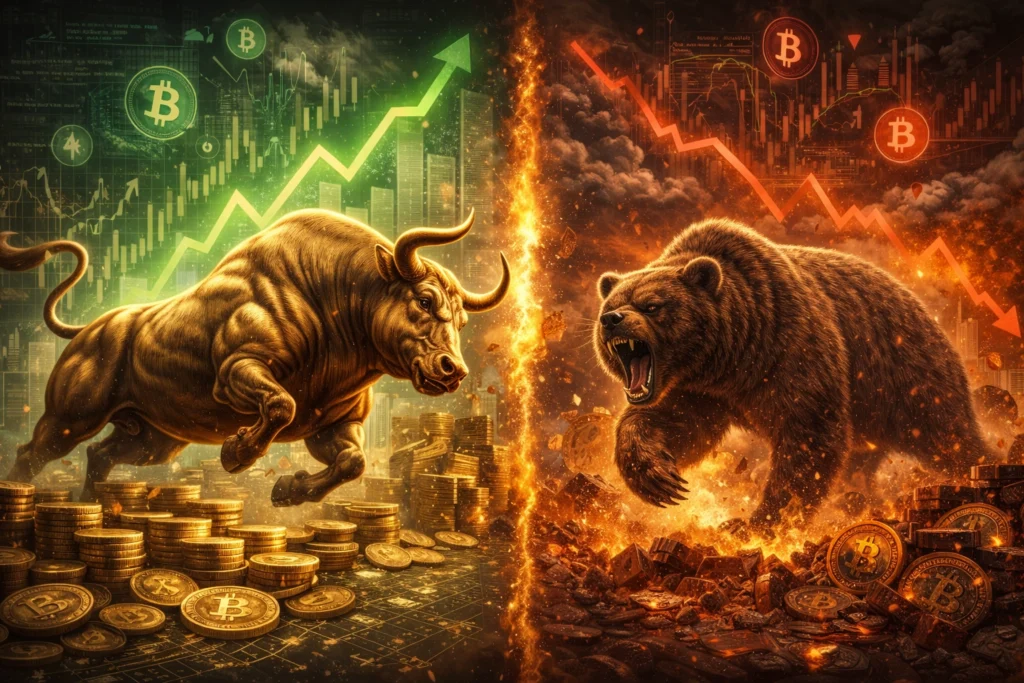
Bull case: the decline proves to be a correction within an uptrend. Catalysts — easing Fed policy, increased inflows to spot ETFs, positive regulatory decisions. BTC returns to previous levels within weeks.
Bear case: the drop is the start of a prolonged downtrend. Catalysts — a US recession, strict regulatory measures against major exchanges, mass outflows from ETFs. Price falls 40–60% from the local peak.
Neutral case: the market enters a consolidation phase. Price oscillates in a range for months. This is typical after sharp moves when the market redistributes positions.
Key terms
Margin call
A requirement from an exchange to add more collateral or the automatic closing of a position when losses reach a threshold.
Funding rate
A periodic payment between holders of long and short positions on perpetual futures that aligns contract price with the market.
Exchange netflow
The difference between BTC volumes flowing into exchanges and volumes withdrawn. A positive value indicates potential selling pressure.
Open interest
The total number of open derivative contracts that have not yet been closed or settled.
Halving
An event that happens roughly every four years: the miner reward per block is cut in half.
Fear & Greed Index
A composite indicator of market sentiment that accounts for volatility, volume, social media, BTC dominance and search trends.
Risk-off
A market regime in which investors reduce exposure to risky assets and move capital into safer instruments.
Order book
A list of all active buy and sell orders on an exchange with specified prices and volumes. Order book depth shows market liquidity.
Additional questions
Is Bitcoin really dead?
No. The phrase “Bitcoin is dead” has appeared in the media hundreds of times since 2010. Each time the network continued to operate and the price later recovered. This is not a guarantee of future growth, but historical context matters.
Should I sell BTC during a sharp drop?
The decision depends on your strategy, investment horizon and risk tolerance. Panic selling at a local bottom locks in losses. If you have clearly defined stop-loss levels — follow them. If not — analyze the reasons for the drop before acting.
How quickly can I check the cause of a drop?
Check the CoinDesk or The Block feed for news. Check CoinGlass for liquidation data. Look at CryptoQuant for exchange flows. Three sources in five minutes will give a basic understanding of the situation.
Does a BTC drop affect altcoins?
Yes, usually more so. Altcoins have lower liquidity and higher volatility. If BTC falls 10%, altcoins can lose 20–40%. This phenomenon is known as “correlation in crisis.”
Is it safe to keep BTC on an exchange during a crash?
Risk increases. During high volatility exchanges can suffer technical failures, delay withdrawals or even halt trading. It’s better to keep the majority of funds on a hardware wallet.
How to protect your funds from the effects of a crash?
Use hardware wallets for long-term storage. Don’t keep all funds on one platform. Set stop-losses in advance. Avoid leverage during periods of uncertainty.
Can a BTC drop be a buying opportunity?
Historically, significant BTC drops became entry points for long-term investors. However, this is not an automatic rule. Buying on a dip requires analysis of fundamental reasons and a clear understanding of your risks.
Where to find reliable analytics for Ukrainian users?
Global sources: Glassnode, CryptoQuant, CoinDesk, The Block. For local context: official NBU announcements, reputable Ukrainian Telegram channels, and exchange and exchanger websites with legal registration in Ukraine.