
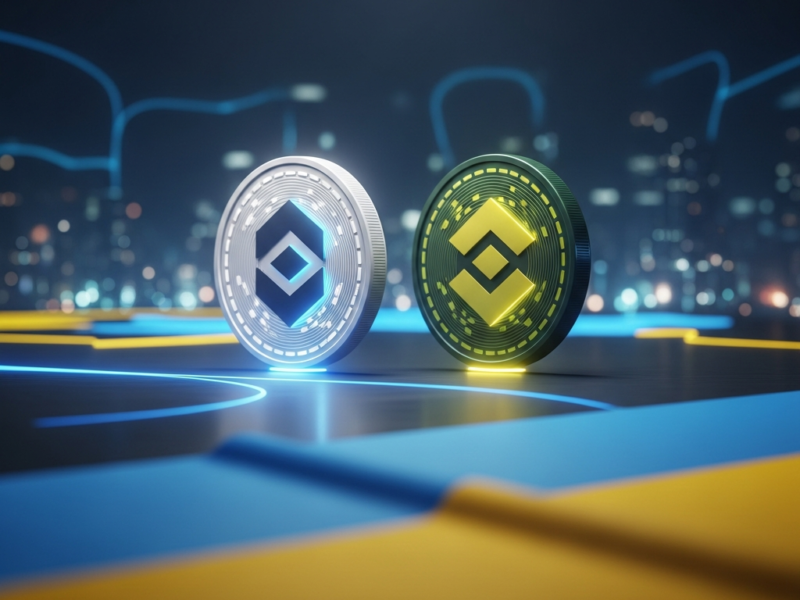
WhiteBIT vs Binance: which exchange should a Ukrainian choose in 2026
Ukrainian crypto investors face the same question every year: where to keep assets, where to trade, and which platform makes working with the hryvnia more convenient. In 2026 this question became even more acute due to changes in the regulatory landscape, new compliance requirements, and the overall rise in interest in digital assets. The topic WhiteBIT vs Binance — which exchange should a Ukrainian choose in 2026 — regularly appears on forums, in Telegram channels and in the comments under reviews. That’s no accident: both platforms have their strengths, but neither is a perfect solution for every scenario.
This is general information and not financial advice.
To make the WhiteBIT vs Binance (Ukraine) comparison useful, you need to consider not only fees or the interface, but also liquidity, fiat channels, security, legal status and the real experience of Ukrainian users. That’s exactly what this piece does — structured, neutral, with practical tips.
The main goal is not to choose for you, but to provide clear criteria for making your own decision. The choice depends on how you plan to use the exchange: for long-term storage, active trading, regular UAH operations, or working with derivatives.
TL;DR
- Binance is stronger in liquidity, number of trading pairs and the set of tools for experienced traders.
- WhiteBIT is more convenient for UAH operations, has local support and is oriented toward the Ukrainian audience.
- Both exchanges’ fees are competitive, but the fee structures differ — compare them for your trading volume.
- No CEX (centralized exchange) is suitable for long-term storage of large sums.
- KYC is required on both platforms; the Ukrainian passport is supported.
- The optimal strategy for most is to use two platforms simultaneously for different tasks.
Find a Secure Crypto ExchangerChoose a verified crypto exchanger in your city
What are Binance and WhiteBIT: a quick overview of each exchange
Binance is the world’s largest crypto exchange by trading volume. Founded in 2017, it operates globally and offers a wide range of products: spot, futures, margin trading, staking, P2P, launchpads, NFT marketplace, lending. As of 2026 Binance holds licenses or registrations in several jurisdictions, although the company’s history includes regulatory conflicts (including settlements with U.S. regulators in 2023).
WhiteBIT is a European crypto exchange founded in 2018 by a team with Ukrainian roots. Registered in Lithuania, it holds licenses in EU countries. It positions itself as a platform focused on security and convenience for users from Central and Eastern Europe. It offers spot trading, futures, P2P, deposit programs, and its own WBT token.
For Ukrainians the key difference at the start is geographic focus. WhiteBIT deliberately works with the Ukrainian audience, while Binance serves a global market.
Fiat and UAH: options for Ukrainians
Availability of hryvnia channels is one of the most important factors when asking which exchange is better for Ukrainians.
WhiteBIT and the hryvnia
WhiteBIT offers direct deposits and withdrawals in UAH via bank cards and P2P. Hryvnia trading pairs are available for major assets (BTC/UAH, USDT/UAH, etc.). Processing time for card operations is usually a few minutes, although fees and limits vary depending on the method.
Binance and the hryvnia
Binance supports UAH mainly through its P2P platform, where Ukrainians can buy or sell crypto for hryvnia directly with other users. Direct top-ups via bank transfer in UAH are limited or unavailable at times — check the current status on the Fiat Deposit page. For large volumes, P2P may be less convenient due to counterparty risk and the need for escrow verification.
If regular UAH operations are your priority, WhiteBIT currently offers a more direct path.
Fees: how to compare WhiteBIT vs Binance fees
Comparing fees without tying them to a specific trading volume is a mistake. Both platforms use a maker/taker fee grid with discounts for volume and for holding native tokens (BNB on Binance, WBT on WhiteBIT).
Spot trading
Binance traditionally offers some of the lowest base rates in the industry, with additional discounts when paying fees in BNB. WhiteBIT has a competitive base rate that can be more advantageous for smaller volumes or local UAH pairs.
Futures and margin
On derivatives markets Binance has a more developed VIP tier system. WhiteBIT also offers futures trading but with fewer pairs and a somewhat different fee model.
Deposits and withdrawals
Crypto withdrawal fees vary by network. For fiat operations in hryvnia — WhiteBIT often has clearer terms without hidden markups. Always check the current fee page of both exchanges before depositing — these conditions change without notice.
| Criterion | Binance | WhiteBIT |
|---|---|---|
| Base spot fee | Lower for large volumes | Competitive for small volumes |
| Discounts via native token | Yes (BNB) | Yes (WBT) |
| Crypto withdrawal fee | Depends on network, usually standard | Depends on network, usually standard |
| UAH deposits: fee | Via P2P — spread; direct — limited | Card/P2P — fixed or percentage fee |
| Futures fees | Flexible, multi-tiered | Competitive, fewer tiers |
| Fee transparency | Public fee page | Public fee page |
Liquidity and order execution
Liquidity directly affects spreads and execution speed. For major pairs (BTC/USDT, ETH/USDT) Binance provides a significantly deeper order book. That means smaller spreads and the ability to fill large orders without substantial price impact.
WhiteBIT has sufficient liquidity for most retail operations, but when trading low-cap altcoins or very large volumes spreads can be noticeably wider. If you’re an active trader placing orders worth tens of thousands of dollars — liquidity differences become a significant factor.
Products and functionality
Binance
Spot trading: over 600 pairs. Futures: USDⓈ-M, COIN-M, options. Earn products: flexible and fixed deposits, staking, dual investments, launchpool. P2P, NFT marketplace, lending, API for algorithmic trading, copy trading.
WhiteBIT
Spot trading: several hundred pairs. Futures: available but with a smaller instrument set. Earn plans with fixed yields, P2P for UAH, copy trading, API. Own loyalty program with the WBT token.
If your scenario involves complex derivatives strategies, margin positions, or wide access to new tokens — in a WhiteBIT vs Binance comparison this clearly favors Binance.
KYC, security and regulation
Both exchanges require KYC (Know Your Customer). A Ukrainian passport or ID card is supported on both platforms. Additional confirmations (source of funds, video verification) may be required for large withdrawals.
Security
Binance has the SAFU fund (Secure Asset Fund for Users) to cover losses from incidents. WhiteBIT states that it stores over 95% of funds in cold wallets and undergoes security audits. Both platforms support 2FA, address whitelisting, and anti-phishing codes.
Regulation
Binance went through significant regulatory processes in 2023–2024 and strengthened compliance. WhiteBIT holds European licenses. For Ukrainian users it’s important to monitor updates to local legislation: NBU rules on crypto operations and tax reporting obligations may change.
How it works in practice
- Define your main use case: regular purchases in hryvnia, active trading, long-term storage, or working with derivatives.
- Register on the chosen platform (or both) and complete KYC — prepare your passport, a selfie, and possibly proof of address.
- Check available fiat channels for UAH: go to the deposit section and make sure your bank or card is supported.
- Make a test deposit with a small amount — check processing speed, fee, and conversion accuracy.
- Set up security: enable 2FA (Google Authenticator or a hardware key), set up withdrawal address whitelisting, and create an anti-phishing code.
- Compare actual fees for your trading pairs — open the fee pages of both exchanges and calculate costs for your volume.
- After trading, export CSV transaction history — you’ll need it for tax reporting.
- Withdraw large sums to a hardware wallet — don’t keep everything on an exchange.
Advantages and limitations
Binance
Advantages: highest liquidity, the widest set of tools, deep discount system for active traders, powerful API.
Limitations: fiat channels for UAH are unstable, support is less localized, the complex interface can intimidate beginners, and there is a regulatory history with negative episodes.
WhiteBIT
Advantages: convenient handling of hryvnia, Ukrainian-language support, simpler interface, local focus.
Limitations: lower liquidity for global pairs, a narrower derivatives offering, fewer altcoins, weaker VIP tiers for large volumes.
Contrarian angle: some Ukrainian traders deliberately choose WhiteBIT not for functionality but because they perceive a lower risk of being subject to global sanctions or compliance checks characteristic of large international platforms. This is not a guarantee of safety, but it is an argument worth considering.
Common mistakes
- “Binance is banned in Ukraine” — no, as of 2026 Binance is available to Ukrainian users, though some features may have restrictions.
- “WhiteBIT is a small exchange, you can’t trust it” — WhiteBIT ranks among the top-20 exchanges by volume and holds European licenses. Size alone is not the only trust criterion.
- “Fees are the same on all exchanges” — no, fee structures, discount tiers and withdrawal fees differ significantly.
- “KYC is optional if you trade small amounts” — both platforms require verification for most operations.
- “You can keep all your savings on an exchange” — centralized custody always carries risk; use hardware wallets for large sums.
- “P2P is completely safe” — counterparty risk exists even with escrow; check the partner’s rating and number of trades.
- “One exchange is enough” — diversifying across platforms reduces the risk of losing access.
Key terms
Maker/Taker
Maker — an order that adds liquidity to the order book. Taker — an order that removes liquidity. Maker fees are usually lower.
KYC (Know Your Customer)
The client identification procedure required on regulated exchanges. It includes submitting documents and sometimes video verification.
Cold Storage
Storing crypto assets on devices not constantly connected to the internet. Reduces the risk of hacks.
P2P (Peer-to-Peer)
Trading directly between users through the exchange with escrow protection. A popular method for fiat operations.
Spread
The difference between the best bid and ask price. A smaller spread means a better execution price.
SAFU
Binance’s Secure Asset Fund for Users, created to compensate losses in case of security incidents.
Whitelisting addresses
A security feature that allows withdrawals only to pre-approved wallet addresses.
Escrow
A mechanism where funds are held temporarily by a third party (the exchange) until a trade between two users is completed.
Liquidity
The market’s ability to absorb large orders without significant price movement. Higher liquidity means smaller spreads and faster execution.
Additional questions
Additional questions
Can I withdraw hryvnia from Binance?
Direct UAH withdrawals to a bank card via Binance are limited or only available via P2P. Check the current withdrawal status on the withdrawal page. P2P allows you to sell crypto for hryvnia and receive a transfer to your card from another user.
What documents are required for KYC on WhiteBIT and Binance?
Both platforms accept a Ukrainian passport or ID card. You may also need a selfie with the document and proof of address. For large amounts — documents proving the source of funds.
Which exchange is cheaper in fees for small amounts?
For volumes up to a few thousand dollars per month the difference in spot fees is usually minimal. The more significant difference is in fiat operation and withdrawal fees, where WhiteBIT can be more transparent for UAH.
Can I use both exchanges at the same time?
Yes, and it’s a recommended approach. Use one platform for fiat operations and the other for trading with higher liquidity. This also reduces the risk of losing access.
Do exchanges provide reports for the tax office?
Both platforms allow exporting transaction history to CSV. Binance also integrates with some tax services. Keep all reports — Ukrainian legislation is moving toward mandatory crypto income declaration.
What to do if an account is blocked?
Contact support through official channels. WhiteBIT has chat and a ticket system with Ukrainian support. Binance offers tickets and chat, but response times for non-VIP users may be longer. Prepare your documents in advance.
Is it safe to use P2P for large amounts?
P2P with escrow reduces risk but does not eliminate it entirely. For large amounts choose counterparties with high ratings and a large number of completed trades. Break the operation into several parts.
When is it better to choose WhiteBIT?
If your priority is regular operations in hryvnia, you need Ukrainian-language support, or a simple interface for basic operations. Also if it’s important for you to operate under a European jurisdiction.
When is it better to choose Binance?
If you are an active trader, need deep liquidity, a wide choice of derivatives, advanced order types, or an API for bots. Also if you trade rare altcoins that are not listed on WhiteBIT.