

What is cryptocurrency and how to make money from it is a question that more and more Ukrainians began asking in 2025, when news outlets were widely reporting that Bitcoin had broken its all-time high (ATH). However, this question remains relevant in 2026 as well.
What is cryptocurrency and how to make money with it in 2026
Digital assets have long ceased to be a niche hobby for programmers. In 2026 cryptocurrency is a global financial instrument with a total market capitalization measured in trillions of dollars. Understanding what cryptocurrency is, how it works and what real earning mechanisms exist becomes a practical skill for anyone who wants to manage their capital intelligently.
This article is a structured guide for those who want to get into the topic from scratch or systematize existing knowledge. We will cover the core technology, key terms, specific ways to make profit and the risks that cannot be ignored.
This is general information and not financial advice.
The material is aimed at a Ukrainian audience: fiat on/off ramps for the hryvnia, tax nuances and storage security in the current regulatory environment are considered separately.
TL;DR
- Cryptocurrency is a digital asset secured by cryptography and recorded in a distributed ledger (blockchain) with no central issuer.
- Main ways to earn: long-term holding, trading, staking, lending, liquidity farming, airdrops, content creation.
- None of the methods guarantee profit; all are subject to market volatility, regulatory and technical risks.
- For Ukrainian users it is critical to choose platforms that support UAH, comply with KYC/AML rules and keep records of transactions.
- Security starts with two-factor authentication, cold storage for large amounts and the rule: never share your seed phrase.
Find a Safe Crypto ExchangeChoose a trusted crypto exchanger in your city
What is cryptocurrency in simple terms
Cryptocurrency is a digital form of money that exists only electronically and is not controlled by any bank or government. Transactions are secured by cryptographic algorithms and recorded on a blockchain — a distributed ledger whose copy is stored simultaneously on thousands of computers around the world.
Imagine a shared Google Doc where everyone can see all entries but no one can secretly change already entered lines. Only instead of text lines, financial operations are recorded: who sent how much to whom.
How it differs from regular money
Fiat currency (hryvnia, dollar) is issued by a central bank. A crypto asset is generated according to protocol rules: for example, Bitcoin has a strictly limited supply of 21 million coins. No one can “print” additional units.
Coin vs token — the difference
Coin — the native asset of its own blockchain: BTC on the Bitcoin network, ETH on the Ethereum network. Token — an asset created on top of an existing blockchain using smart contracts. For example, USDT (Tether) operates on several networks but does not have its own blockchain.
How blockchain works and basic terms
Blockchain is a sequential chain of data blocks where each new block contains a cryptographic fingerprint of the previous one. Changing a single record requires recalculating the entire chain, making falsification practically impossible.
Consensus mechanisms
- Proof-of-Work (PoW) — miners solve computational puzzles to create a new block and receive a reward. Requires powerful hardware and significant electricity.
- Proof-of-Stake (PoS) — validators lock up a certain amount of coins as collateral. The right to create a block is determined by an algorithm that takes stake size into account. Much more energy-efficient.
Wallets and keys
A custodial wallet stores private keys on the provider’s side (an exchange). A non-custodial wallet — you control the keys yourself. Seed phrase — a set of 12–24 words that allows you to recover access to a wallet. Losing it means irreversible loss of funds.
How it works in practice
From the idea to the first operation — a path of concrete steps.
- Choose a reliable exchange or platform. For Ukrainian users — one that supports UAH deposits and withdrawals and requires verification (KYC).
- Complete verification. Upload documents, confirm your identity. This is required by most legal platforms and protects against fraud.
- Fund your account with fiat. Bank transfer, card or P2P exchange using the platform’s escrow service.
- Buy a crypto asset. Start with a small amount you can afford to lose. Check purchase fees and spreads.
- Transfer to secure storage. For large amounts — non-custodial or hardware wallet. Make a small test transfer before the main one.
- Choose a strategy. Long-term holding, staking or active trading — depending on experience, time resources and risk tolerance.
- Keep records of transactions. Record the date, amount and rate of each transaction. This is necessary for tax reporting and tracking profitability.
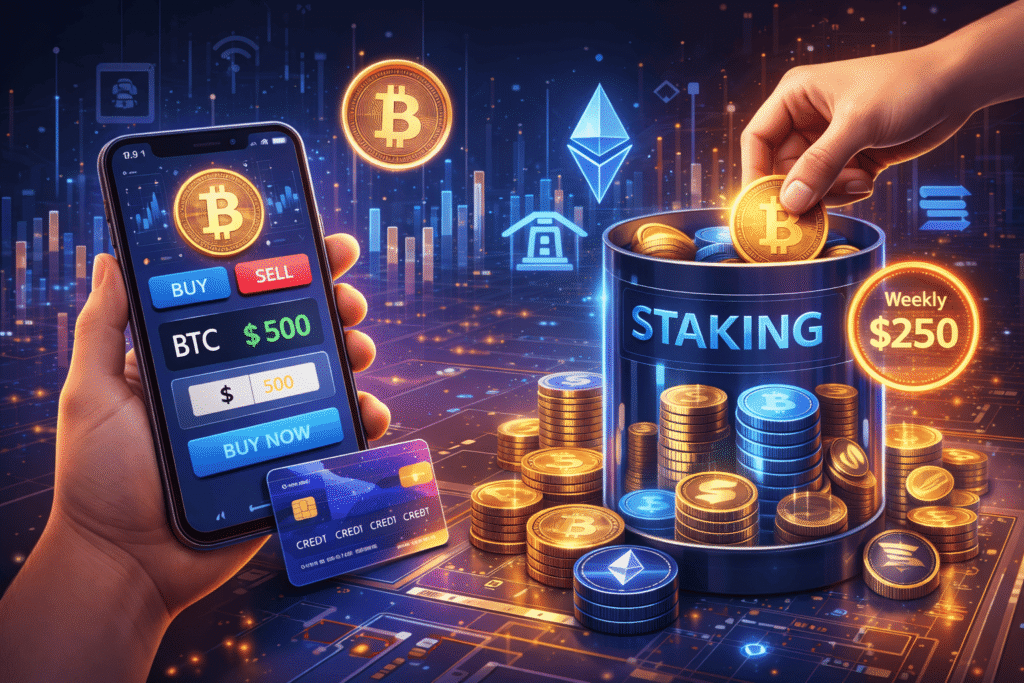
Ways to make money with cryptocurrency in 2026
The question “how to make money with cryptocurrency” has no single answer. Each method has its own return and risk profile.
Buying and holding (HODL)
The idea is to buy an asset and hold it for months or years expecting price appreciation. Suitable for those who believe in the long-term potential of a specific project. The key is to choose an asset based on fundamental analysis rather than hype, and to set an exit point in advance.
Trading
Spot trading — buying and selling at the current price. Margin trading — using leverage, which amplifies both profits and losses. Requires knowledge of technical analysis, strict risk management and discipline. Fees and spreads reduce real profitability.
Staking
Locking coins to support a PoS network in return for rewards. Some protocols allow delegating coins to a validator without a minimum threshold. Assets are locked for a defined period — liquidity is limited.
Lending
Lending assets through a CeFi platform or DeFi protocol for an interest rate. Risks: bankruptcy of a centralized platform, smart contract vulnerabilities, liquidation cascades during sharp market drops.
Liquidity farming
Providing a pair of tokens to a decentralized pool to enable trading. Earnings come from a share of trading fees and often additional token rewards. The main caveat is impermanent loss — when price changes of the pair reduce your real position compared to simple holding.
Airdrops and testnets
Projects distribute tokens for early testing, completing tasks or network activity. Returns are unpredictable but costs are usually minimal. It’s important to verify a project’s authenticity — fraudulent airdrops are used for phishing.
NFTs and Play-to-Earn
Creating, buying or reselling non-fungible tokens, and game models with earning opportunities. The market is cyclical: periods of hype are followed by long downturns. Liquidity for a specific NFT can be zero.
Affiliate programs and content
Referral payments from exchanges, educational content, consulting. Income does not directly depend on market swings but requires an audience and time.
CeFi vs DeFi: comparing approaches
Choosing between centralized and decentralized financial services is one of the first decisions that affects control, security and access to tools.
| Criterion | CeFi | DeFi |
|---|---|---|
| Control over assets | The platform holds the keys | The user controls the keys |
| Verification | KYC is mandatory | Usually anonymous |
| Customer support | There is customer support | None, only the community |
| Liquidity | High on major exchanges | Depends on the specific pool |
| Risk of hacks | Attack on exchange infrastructure | Smart contract vulnerabilities |
| Access to UAH on/off ramp | Available on major platforms | Limited, via aggregators |
| Regulatory transparency | Higher, licenses | Jurisdiction is blurred |
| Complexity for a beginner | Lower | Higher, technical skills required |
When to choose CeFi: if your priority is simplicity, hryvnia support and a familiar interface. When to choose DeFi: if you value full control, anonymity and access to niche farming tools.
Advantages and limitations
Digital assets offer opportunities unavailable in traditional finance but also create specific limitations.
Advantages: global accessibility independent of banking hours; transaction transparency thanks to a public ledger; the ability to micro-invest — you can start with the equivalent of a few dollars; programmable finance via smart contracts; potential returns higher than traditional deposits (but with higher risk).
Limitations: volatility that can wipe out a significant portion of capital within hours; regulatory uncertainty, especially in jurisdictions with evolving legislation; a technical entry barrier for DeFi; irreversibility of transactions — an erroneous transfer cannot be canceled; limited recognition as a means of payment.
A counterintuitive nuance: the highest returns are often promised by the riskiest protocols. If a yield looks unrealistically attractive — that’s almost always a signal of elevated risk or hidden costs.
Risks to be aware of
- Market volatility — the price of an asset can fall by tens of percent in a day.
- Regulatory changes — new laws or sanctions can limit access to services or change tax rules.
- Cybersecurity — phishing sites, fake apps, targeted attacks on wallets.
- Counterparty risk — bankruptcy of a centralized exchange or lending platform.
- DeFi-specific — unaudited contracts, rug-pull schemes, oracle manipulation.
- Liquidity — inability to sell an asset quickly without a significant discount.
- Psychological factors — FOMO (fear of missing out), panic selling, overuse of leverage.
Common mistakes
- “Cryptocurrency is always a quick way to make money.” Most market participants who trade short-term lose capital. Profitable strategies require knowledge, discipline and time.
- “Buying Bitcoin is enough — that’s it.” Diversification remains a basic principle. Even the largest market asset undergoes deep corrections.
- “DeFi is completely safe because there are no intermediaries.” Smart contracts can contain vulnerabilities. The absence of an intermediary also means no one will reimburse losses.
- “You can store your seed phrase in phone notes.” Any digital storage is a potential target for attackers. Seed phrases should be written on a physical medium and stored offline.
- “You don’t need to pay taxes on crypto in Ukraine.” Income from digital asset operations is taxable. Lack of final legislation does not exempt you from declaring.
- “The higher the leverage, the higher the profit.” 10x leverage means a 10% move against your position will fully liquidate your deposit.
Advice for Ukrainian users
Choose platforms that support UAH and have transparent deposit and withdrawal terms. Compare conversion and transfer fees. For P2P operations use the exchange’s built-in escrow services — do not transfer funds directly to strangers.
Keep a transaction journal noting the date, amount in crypto and the equivalent in hryvnia. Save statements and confirmations. Consult a tax advisor about current rules.
For amounts you don’t plan to use daily, use a hardware wallet. Enable two-factor authentication on all accounts. Use unique passwords and a password manager.
Follow official announcements from the Ministry of Digital Transformation and the National Bank of Ukraine (NBU) and legislative initiatives regarding digital asset regulation. Plan withdrawals taking into account possible banking restrictions.
Key terms
Blockchain
A distributed ledger where data is recorded in sequential blocks protected by cryptography. Ensures transparency and immutability of transactions.
Smart contract
A program that automatically enforces the terms of an agreement when specified conditions are met. Runs on a blockchain without an intermediary.
Stablecoin
A token pegged to a stable asset (dollar, gold). Used to hedge volatility and as a unit of account.
Staking
Locking coins in a PoS network to support transaction validation in return for rewards.
Impermanent loss
Temporary losses incurred by liquidity providers when the price of assets in a pair changes relative to the moment of deposit.
Seed phrase
A set of 12–24 words to recover access to a non-custodial wallet. The only way to regain control if you lose your device.
Layer 1 and Layer 2
Layer 1 — the base blockchain (Bitcoin, Ethereum). Layer 2 — an off-chain scaling solution that processes transactions outside the main chain with subsequent settlement.
Rug-pull
A fraudulent scheme where a project team takes investors’ funds and disappears. Typical for unaudited DeFi protocols.
KYC/AML
Know Your Customer / Anti-Money Laundering — customer identification and anti-money laundering procedures required by legal platforms.
Additional questions
Is it legal to hold cryptocurrency in Ukraine?
Owning digital assets is not prohibited. The Law on Virtual Assets defines the legal status, although bylaws and full regulatory mechanisms are still being developed. It is recommended to follow updates from the Ministry of Digital Transformation and the NBU.
How much money do you need to start?
Technically — from the equivalent of a few dollars. Most exchanges allow small purchases. The critical rule: only invest an amount whose loss would not affect your basic needs.
What is staking and is it passive income?
Staking is locking coins to support a PoS network in exchange for rewards. It is conditionally passive: it requires choosing a validator, monitoring network conditions and understanding the risk of asset lock-up.
How to minimize tax burden?
Keep detailed records, use FIFO or another allowed method to calculate cost basis, record losses to reduce the taxable base. Specific rates and rules require consultation with a specialist.
Can you lose all invested funds?
Yes. Complete loss is possible due to an asset price crash, platform bankruptcy, a hacked smart contract or loss of wallet access. Risk management and diversification are mandatory.
What is the difference between an exchange and a wallet?
An exchange is a trading venue where buying and selling occurs. A wallet is a tool for storage. A custodial exchange wallet is convenient but you do not control the keys. A non-custodial wallet gives full control but also full responsibility.
Should a beginner use leverage?
No. Margin trading amplifies losses many times. Without solid experience and a tested strategy, leverage is the quickest way to lose your deposit.
How to check the reliability of a DeFi protocol?
Check for audits by recognized firms, the amount of liquidity in pools, the project’s history and code openness. Lack of an audit is a serious red flag.