
Last updated: November 2, 2026.
Still keeping all your Bitcoin, Ethereum, or USDT on Binance? The events of October 2026 should make you think twice.
On October 29, 2026, Binance suffered a major security breach. According to the exchange’s official announcement, attackers compromised its hot wallets and stole approximately $6.3 billion in crypto assets.
Binance temporarily suspended withdrawals, launched an investigation, and promised to cover the losses using its own funds and the Secure Asset Fund for Users (SAFU).
Imagine opening your exchange account and seeing $10,000 in Bitcoin and USDT. The balance is there. You know your password. Your two-factor authentication works.
But you can’t withdraw your money.
That’s what makes exchange custody risky. Your account balance and your ability to move the underlying assets aren’t necessarily the same thing.
On November 1, Binance began restoring withdrawals in phases. The exchange also reported that it had replenished approximately 95% of the affected assets using company resources. That figure referred to replacing assets backing customer balances, not recovering 95% of the stolen funds from attackers.
Sources: Binance Security Incident Update, October 30, 2026 and Withdrawal Recovery Update, November 1, 2026.
So here’s the question that matters: where should you store cryptocurrency if even one of the world’s largest exchanges can temporarily lose control of its withdrawal infrastructure?
The answer isn’t simply “buy a Ledger” or “download Trust Wallet.”
You need to understand who controls your private keys, how different wallets fail, and why keeping your entire crypto portfolio in one place creates an unnecessary point of failure.
This guide explains where to store cryptocurrency safely in 2026, how to protect Bitcoin, Ethereum, and USDT, and what Ukrainian crypto users should consider when choosing between exchanges, hardware wallets, and self-custody.
Where to Store Cryptocurrency: The Short Answer
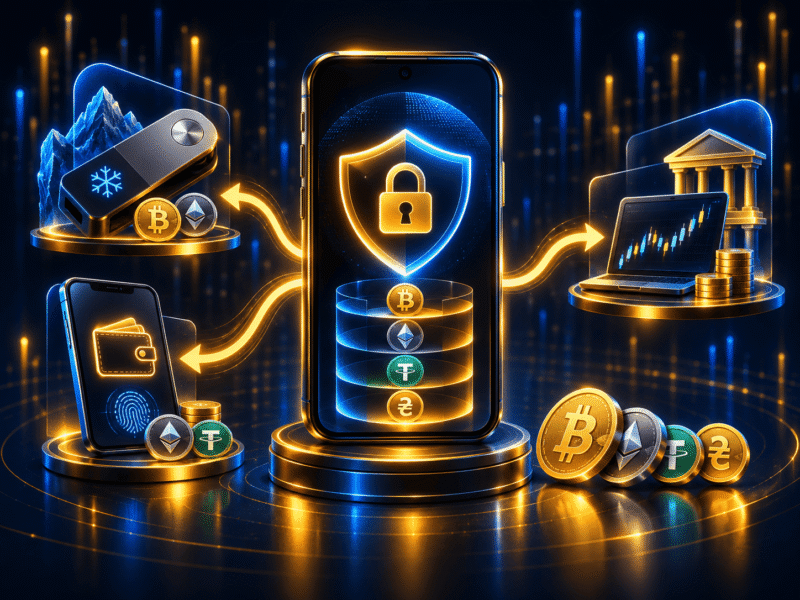
For long-term cryptocurrency storage, a properly configured non-custodial hardware wallet is generally one of the strongest options. Use a separate self-custody mobile wallet for everyday transfers, and keep only the amount needed for trading on centralized exchanges.
For larger holdings, consider spreading your assets across independently controlled wallets rather than relying on a single device, seed phrase, or provider.
A practical cryptocurrency storage setup can include:
- Cold hardware wallet: For long-term Bitcoin, Ethereum, and other supported cryptocurrency savings.
- Non-custodial mobile wallet: For regular USDT transfers, payments, and smaller working balances.
- Centralized crypto exchange: For trading, converting assets, and occasional withdrawals to fiat currency.
- Additional independent wallet: For reducing the consequences of losing or compromising one set of private keys.
Does everyone need four different wallets? No.
If you own $300 in cryptocurrency, one reliable self-custody wallet with a properly protected backup may be enough. If you’re managing $50,000 or more, relying on a single wallet or exchange deserves a much closer look.
The principle is simple: don’t put your entire cryptocurrency balance somewhere that could become inaccessible because of one security incident, one lost device, or one compromised recovery phrase.
Why Cryptocurrency Storage Matters Especially in Ukraine
For many Ukrainians, cryptocurrency isn’t just something to trade.
People use Bitcoin as a long-term investment, receive international payments in USDT, send money across borders, and hold digital assets outside traditional banking accounts.
According to the Chainalysis Global Crypto Adoption Index 2026, Ukraine ranked seventh worldwide for grassroots cryptocurrency adoption.
That ranking measures crypto activity, not the safety of exchanges or wallets. Still, it demonstrates how relevant digital assets have become to Ukrainian users.
There are also specific challenges to consider.
Exchange access and Ukrainian hryvnia services can change
In September 2026, Binance announced changes to its Ukrainian hryvnia services, including the discontinuation of UAH deposits and withdrawals through Fiat Trade UAH and the removal of the USDT/UAH spot trading pair.
These changes did not mean Binance stopped serving every Ukrainian customer or eliminated all UAH-related P2P activity. They affected specific products and payment routes.
For someone who relied on those services, though, the impact was real: a familiar way of moving between hryvnia and cryptocurrency disappeared.
Read our related article: Binance UAH and USDT/UAH Closing: What Ukrainian Users Should Do.
Banking and financial monitoring
Buying cryptocurrency, selling USDT through P2P platforms, or receiving large bank transfers may trigger additional verification.
Banks and payment providers can request documents showing where the funds came from. Exchange services may also apply KYC and anti-money-laundering checks.
Holding cryptocurrency in a private wallet doesn’t automatically remove these obligations when you eventually convert it into conventional money.
Physical access and emergency recovery
There’s another issue that matters in Ukraine: the possibility of having to leave your home unexpectedly.
A phone can be lost. A laptop can be damaged. Your hardware wallet might be left behind during an evacuation.
That’s why a sound storage plan needs to answer two questions:
Can someone steal my crypto?
And can I still access it if I lose the device I normally use?
A wallet that protects against hackers but leaves you unable to recover your funds after losing one device isn’t a complete solution.

Why You Shouldn’t Store All Your Cryptocurrency on Binance or Other Exchanges
Binance, Bybit, and other major centralized exchanges offer useful services. They make trading, buying, selling, and converting crypto relatively convenient.
But convenience doesn’t mean your savings should remain on an exchange forever.
The 2019 Binance hack: 7,000 BTC stolen
On May 7, 2019, Binance reported the theft of 7,000 BTC from one of its hot wallets.
Attackers used a combination of phishing, malware, and stolen account-related data, including API keys and two-factor authentication information.
The stolen Bitcoin was worth approximately $40 million at the time.
This was an early reminder that exchange infrastructure can be compromised even when a company has extensive security controls.
The October 2026 Binance hack: approximately $6.3 billion
Seven years later, Binance experienced a substantially larger incident.
On October 29, 2026, attackers made unauthorized withdrawals from compromised hot wallets, resulting in an estimated loss of $6.3 billion in cryptocurrency.
The company’s initial investigation considered a compromised DevOps engineer’s laptop as a possible entry point. Subsequent investigation identified additional points of compromise.
At the time of the October 30 update, Binance said it had found no evidence that wallet private keys had leaked. Its technical investigation was still ongoing.
Binance committed to covering the losses using company resources and the SAFU fund.
That commitment matters. But it doesn’t eliminate the problem of temporary loss of access.
If an exchange pauses withdrawals, you can’t independently move your exchange-held assets to another wallet, even if your account still displays the full balance.
What if you need that money for rent, relocation, healthcare, or another urgent expense?
That’s the part many crypto holders overlook.
The 2025 Bybit hack: $1.5 billion stolen
On February 21, 2025, Bybit suffered a major cryptocurrency theft involving approximately $1.5 billion in digital assets.
The FBI later attributed the incident to North Korean malicious cyber activity associated with TraderTraitor.
Source: FBI: North Korea Responsible for $1.5 Billion Bybit Hack.
One important detail is that the attack involved the transaction-signing process associated with an exchange cold wallet.
This illustrates a distinction that matters for cryptocurrency storage: an exchange using cold storage doesn’t mean its overall custody process is impossible to compromise.
Security depends on how keys, approvals, signing systems, and people interact.
The main risks of storing cryptocurrency on an exchange
- Exchange hacks. Attackers may exploit infrastructure vulnerabilities without directly compromising your personal account.
- Withdrawal suspensions. Platforms can temporarily restrict transfers during incidents, maintenance, or security reviews.
- Account restrictions. AML checks, sanctions requirements, or suspicious activity may trigger additional verification or limitations.
- Financial distress. If a custodian becomes insolvent, asset recovery may depend on legal proceedings and available reserves.
- Changes in service availability. Exchanges can stop supporting particular countries, payment methods, currencies, or networks.
Should you stop using centralized exchanges entirely?
Not necessarily.
They’re useful for trading. The mistake is assuming that the best place to trade cryptocurrency must also be the best place to store your savings.
You can compare platforms in ZIND’s crypto exchange directory for Ukraine.
Custodial vs. Non-Custodial Wallets: What’s the Difference?
Before deciding where to store Bitcoin, Ethereum, or USDT, understand one thing.
Who controls the private keys?
Cryptocurrency doesn’t physically sit inside a smartphone application, USB drive, or hardware wallet. Assets and transactions are recorded on their respective blockchains.
A crypto wallet manages the cryptographic keys needed to authorize transactions.
What is a custodial wallet?
A custodial wallet is a wallet or account in which a third-party provider controls the private keys.
A typical example is your balance on a centralized exchange.
You log in using an email address, password, and authentication method. If you forget your password, the provider may offer an account recovery procedure.
That’s convenient.
But the provider operates the underlying custody infrastructure. If it restricts withdrawals, you generally can’t bypass that restriction by signing the blockchain transaction yourself.
What is a non-custodial wallet?
A non-custodial wallet, also called a self-custody wallet, gives you independent control over the keys used to authorize cryptocurrency transactions.
Examples of self-custody products include Trust Wallet, MetaMask, Ledger, and Trezor, although recovery methods and security designs differ between products.
Traditional non-custodial wallets use a recovery phrase, private key backup, or another mechanism controlled by the user.
You can usually send funds without requesting permission from a centralized exchange, provided the blockchain is functioning and the asset itself isn’t restricted at the token-contract level.
The downside is serious.
If you lose your only recovery method and access to every device that holds the keys, your cryptocurrency may become permanently inaccessible.
There may be no customer support team capable of resetting that access.
Custodial vs. self-custody storage comparison
| Factor | Custodial storage | Non-custodial storage |
|---|---|---|
| Private key control | Third-party provider | User or chosen self-custody setup |
| Account recovery | Usually through the provider | Through backup keys or another recovery mechanism |
| Dependence on an exchange | High | Not required for ordinary wallet transfers |
| Risk of account restrictions | Present | No traditional exchange account to restrict |
| Responsibility for keys | Primarily the provider | Primarily the user |
| Convenience for trading | Usually high | May require a separate exchange step |
| Long-term storage | Additional third-party risks | Suitable when properly secured |
For a closer look at individual products, visit ZIND’s crypto wallets comparison for Ukraine.
Where to Store Crypto: Four Main Options Compared
There isn’t one wallet that’s best for everybody.
Someone who transfers USDT several times a week has different needs from a Bitcoin investor who plans to hold their coins for ten years.
Let’s compare the most practical cryptocurrency storage options.
1. Hardware wallets: Best suited for long-term crypto storage
A hardware wallet is a dedicated physical device designed to manage and protect cryptocurrency private keys.
It normally keeps key material isolated from the everyday operating environment of an internet-connected laptop or smartphone.
Popular manufacturers include:
- Ledger
- Trezor
- SafePal
Here’s a simple example.
You purchase a Trezor, initialize it yourself, create a recovery backup, and transfer Bitcoin to an address controlled by that device.
When you later want to send Bitcoin, the hardware wallet signs the transaction without exposing the private key to the computer preparing it.
That makes direct key theft through ordinary computer malware considerably harder.
But don’t confuse isolation with perfect protection.
If you approve a malicious transaction, enter your recovery phrase on a phishing website, or misunderstand what you’re signing, the hardware wallet may not prevent the loss.
Advantages of hardware wallets:
- Private keys are isolated from the main computer or phone environment.
- Transactions can be verified and approved on a dedicated device.
- Well suited to holdings that aren’t moved frequently.
- Funds can usually be recovered from a compatible backup if the device fails.
Disadvantages:
- Hardware costs money and requires proper setup.
- The recovery phrase still needs strong protection.
- Daily transfers can be less convenient than using a mobile app.
- Supported networks, coins, and recovery features differ between models.
Buy devices from official manufacturers or authorized sellers. Never trust a hardware wallet that arrives with a prewritten seed phrase supplied by someone else.
If you’re asking where to store a large amount of cryptocurrency for several years, hardware cold storage should be near the top of your list.
2. Mobile self-custody wallets: Better for everyday transactions
Now imagine you receive freelance payments in USDT and regularly send cryptocurrency to family members or exchange services.
Connecting a hardware wallet for every small transaction gets annoying.
That’s where mobile hot wallets make sense.
Examples include:
- Trust Wallet: A multi-chain mobile wallet for transfers and managing supported crypto assets.
- MetaMask: A widely used wallet for Ethereum and compatible EVM networks.
- Exodus: A software wallet with desktop and mobile interfaces.
- Phantom: A wallet commonly used in the Solana ecosystem and other supported networks.
Before choosing a wallet, verify that it supports the exact cryptocurrency and blockchain network you need.
For example, a wallet supporting Ethereum tokens doesn’t automatically support native Bitcoin or USDT on TRON.
A self-custody mobile wallet gives you more direct control over transfers without having to request withdrawal permission from an exchange.
However, your phone is connected to the internet, runs other applications, and can be exposed to phishing or malicious software.
That makes a mobile wallet useful for smaller operational balances, but potentially unsuitable as the only place holding your entire savings.
3. Browser wallets: Convenient for DeFi, but exposed to smart-contract risks
Browser wallets such as MetaMask let you interact with decentralized exchanges, NFT platforms, lending applications, and other Web3 services.
They’re useful tools. They’re also easy to misuse.
An attacker doesn’t necessarily need your private key to steal tokens.
Sometimes the user signs a malicious transaction or grants a smart contract permission to spend tokens.
These permissions are commonly called token approvals.
An unlimited approval can remain active long after you’ve disconnected your wallet from a website.
As explained in Ethereum.org’s guide to revoking token access, disconnecting a decentralized application doesn’t automatically revoke existing on-chain permissions.
That’s why it’s sensible to use a separate wallet for experimental DeFi activity.
Don’t connect your main long-term savings wallet to unfamiliar applications just because a website offers an attractive yield or a free token.
4. Centralized exchanges: Convenient for trading, not ideal for all savings
Centralized exchanges are designed to make buying, selling, and converting cryptocurrencies easy.
They offer order books, trading pairs, account histories, and other tools.
But the exchange controls the systems that custody your assets.
For a small trading balance, that trade-off may be acceptable.
For Bitcoin you intend to hold for the next five years, an exchange may provide little storage-related advantage compared with direct self-custody.
Crypto Storage Methods: Quick Comparison
| Storage method | Best use | Main advantage | Main risk |
|---|---|---|---|
| Hardware cold wallet | Long-term BTC, ETH, and other supported assets | Private key isolation | Backup loss or signing mistakes |
| Mobile self-custody wallet | USDT transfers and everyday crypto payments | Convenient independent access | Device compromise and phishing |
| Browser Web3 wallet | DeFi, NFTs, and decentralized applications | Direct smart-contract interaction | Malicious approvals and signatures |
| Centralized exchange | Trading and crypto-to-fiat conversion | Trading access and liquidity | Exchange hacks and withdrawal restrictions |
Notice something?
No method wins in every category.
The safest place to store cryptocurrency depends on how often you need to move it, the value involved, and whether you can manage private keys without making costly mistakes.
Should You Split Cryptocurrency Between Different Wallets?
For larger holdings, yes. Dividing assets across independently controlled storage locations can reduce the impact of a single failure.
Let’s say you own a crypto portfolio worth $10,000.
You intend to hold most of it long term, occasionally transfer USDT, and keep some funds ready for trading.
One possible storage arrangement looks like this:
| Storage location | Share | Example amount | Purpose |
|---|---|---|---|
| Hardware cold wallet | 70% | $7,000 | Long-term savings |
| Separate self-custody wallet | 20% | $2,000 | Regular transfers |
| Centralized exchange | 10% | $1,000 | Trading and conversion |
This is an illustrative storage arrangement, not an investment allocation recommendation or a guarantee of security. Your actual setup should reflect your holdings, transaction habits, and technical ability.
In this example, a temporary exchange withdrawal suspension wouldn’t prevent you from accessing most of your cryptocurrency.
If the mobile wallet were compromised, your long-term holdings would remain in a separately secured environment.
But there’s a common mistake here.
Creating three addresses from the same seed phrase doesn’t create three independent security domains.
If someone steals that recovery phrase, they may gain access to all addresses derived from it.
True separation requires independently generated keys and appropriately separated backups, not simply different wallet apps importing the same seed phrase.
Where to store cryptocurrency if you own less than $1,000
One reputable self-custody wallet may be sufficient for a relatively small balance.
Before buying expensive hardware, learn how to back up the wallet, recognize scams, and verify receiving addresses.
Security habits matter more than collecting devices you don’t understand.
Where to store cryptocurrency worth $1,000 to $10,000
At this level, a hardware wallet becomes worth considering for long-term holdings.
You can keep an operational balance on a mobile wallet and leave only the funds needed for trading on an exchange.
Remember that storage security doesn’t protect you from market volatility or the failure of a cryptocurrency itself.
Where to store large cryptocurrency holdings
For portfolios worth tens of thousands of dollars or more, it may make sense to consider independent hardware wallets, geographically separated backups, and more advanced authorization systems.
Multisignature setups can also be useful for experienced users.
However, complicated systems introduce new operational risks. If you can’t recover them correctly, additional complexity may make your funds less secure rather than more secure.
Where to Store USDT Safely in Ukraine
For many people in Ukraine, the question of where to store cryptocurrency is really a question about USDT.
USDT is commonly used for transfers, international payments, and holding assets denominated in US-dollar terms.
But USDT is not the same thing as US dollars in a bank account.
Its value and redeemability depend on the issuer, reserve arrangements, market liquidity, and other factors.
There’s another issue that people often miss.
USDT is issued by a centralized company. Depending on the blockchain and implementation, Tether has mechanisms that can restrict transfers involving particular addresses.
Similar address-blocking provisions exist for USDC, as described in Circle’s official USDC terms.
So you can hold USDT in your own hardware wallet, control the private keys, and still face risks associated with the token issuer.
Self-custody protects your ability to control wallet keys. It doesn’t remove issuer, depegging, smart-contract, or network risks from stablecoins.
Which blockchain should you use to store USDT?
USDT is available on multiple blockchains and through different token implementations.
The right choice depends on wallet compatibility, the recipient’s supported network, fees, and the specific token contract.
| Network | Typical use | What to check |
|---|---|---|
| TRON (TRC20) | Common USDT transfers between supported services | TRX or network resources may be needed for outgoing transfers |
| Ethereum (ERC20) | Ethereum wallets and DeFi applications | ETH network fees can vary |
| BNB Smart Chain (BEP20) | Transfers and applications on BNB Smart Chain | BNB gas fees and the exact token contract |
| Solana | Fast transfers within the Solana ecosystem | Supported token version and SOL for transaction fees |
For BNB Smart Chain and other networks, verify whether you’re dealing with an issuer-supported token or a bridged or pegged representation. Tokens with similar names can have different issuers and risks.
Never select a withdrawal network just because its fee is lower.
If a recipient accepts USDT on TRON only, sending USDT through Ethereum may leave the funds uncredited.
This becomes particularly confusing with EVM-compatible chains, where addresses can look identical across multiple networks.
For a detailed comparison, read USDT TRC20 vs. ERC20 vs. BEP20: Which Network Should You Choose?.
How to Store Your Seed Phrase and Private Keys Safely
You can buy an expensive hardware wallet, use a separate laptop, and create a strong PIN.
Then ruin the entire setup by taking a photo of your recovery phrase and uploading it to cloud storage.
Yes, that happens.
A seed phrase, also known as a recovery phrase, commonly consists of 12 or 24 words. Some backup standards use different word counts and recovery formats.
In traditional wallets, this information can allow someone to recreate the corresponding private keys and access the assets.
If an attacker obtains your valid recovery phrase, your device PIN may no longer protect the funds.
Trezor advises users to keep wallet backups away from ordinary digital storage such as screenshots, cloud drives, and email accounts.
Source: Trezor: How to Use a Wallet Backup.
Practical seed phrase security rules
- Record your recovery phrase offline. Check every word and its order.
- Don’t send it through messaging apps. Not even to your own saved messages.
- Avoid unprotected digital copies. Screenshots, photo galleries, and ordinary cloud notes can expose your backup.
- Never enter it on an unfamiliar website. A legitimate blockchain explorer doesn’t need your seed phrase to display a transaction.
- Consider protected physical backups. Paper or durable metal backups stored securely in separate locations can reduce some physical risks, but each accessible copy also creates a potential theft risk.
- Learn the recovery process before transferring large amounts. Follow official device instructions and never test a phrase by submitting it to an unknown online tool.
Some hardware wallets also support an additional passphrase.
This may provide another security layer, but it creates a new recovery responsibility: losing the additional passphrase can mean losing access to the corresponding wallet even when the original recovery phrase is intact.
Don’t add complexity until you understand exactly how recovery works.
For users in Ukraine, it’s especially important to plan for relocation, device loss, and periods when a physical storage location might be inaccessible.
Your crypto should remain recoverable without depending entirely on today’s phone or computer.
How to Move Cryptocurrency From Binance to Your Own Wallet
Decided to move some long-term holdings off an exchange?
Don’t rush to transfer the entire balance in one transaction.
Blockchain transfers can be irreversible. One incorrect address or network selection may create a very expensive problem.
Step 1: Create a non-custodial wallet
Choose a wallet that supports the cryptocurrency and network you intend to receive.
Install the official application or initialize your hardware device according to the manufacturer’s instructions.
Create a new wallet and securely back up its recovery information.
Make sure you’re actually using a self-custody wallet rather than opening another account operated by a third-party custodian.
Step 2: Select the correct asset and blockchain
Suppose you have USDT on Binance and want to receive it through TRON.
Open the receiving wallet’s USDT address for TRON (TRC20).
When withdrawing from Binance, select the matching network if withdrawals through that network are available.
Don’t choose Ethereum, BNB Smart Chain, or another network just because the withdrawal fee looks better.
Step 3: Send a small test transaction
Transfer a small amount first, taking account of minimum withdrawal limits and fees.
Wait for the transaction to be confirmed and verify that the correct token arrived in your wallet.
Only then consider moving the remaining balance.
Step 4: Verify the receiving address
Malware can replace a copied address in your clipboard. Address-poisoning scams can also place similar-looking addresses into your transaction history.
Check the complete address through a trusted interface. When using a hardware wallet, verify the address or transaction details on the device screen wherever supported.
Step 5: Save the transaction record
Keep the date, asset, amount, network, receiving address, and transaction hash (TXID).
These details help you investigate missing transfers and maintain an accurate history of crypto transactions.
If an exchange temporarily suspends withdrawals, don’t pay unknown intermediaries claiming they can bypass the restriction.
Check official notices and use the exchange’s legitimate support channels.
Five Cryptocurrency Storage Mistakes That Can Cost You Everything
1. Keeping every asset in one wallet
If the same wallet holds your savings, receives payments, and connects to unfamiliar DeFi applications, one compromised key or malicious approval may threaten your entire balance.
Separate long-term savings from everyday transactions.
2. Assuming self-custody means you can’t be hacked
A non-custodial wallet doesn’t eliminate phishing, malware, fraudulent transactions, or human error.
It gives you control over your funds, along with responsibility for protecting that control.
3. Storing your backup next to the wallet
Imagine keeping your phone, hardware wallet, and paper recovery phrase in the same bag.
One theft or physical accident could affect all of them.
Use separate, secure locations where appropriate, and consider the risks of unauthorized access to each backup.
4. Confusing crypto storage with staking or yield products
Holding ETH in your own wallet is different from depositing ETH into a lending protocol or yield-generating service.
Staking and DeFi services can introduce risks associated with smart contracts, liquidity, validator penalties, custodians, and market conditions.
An advertised yield of 8%, 15%, or 20% doesn’t make the underlying service safe.
Before using any yield product, understand who controls the assets and how returns are generated.
ZIND provides a separate crypto staking platform comparison for reviewing available options.
5. Having no recovery plan
What happens if your hardware wallet stops working?
What if your phone is stolen?
And what if your family needs access to your cryptocurrency after your death?
A long-term storage plan should account for recovery, emergencies, and inheritance.
For significant holdings, consider seeking legal advice about estate planning and how recovery instructions can be securely preserved for legitimate heirs.
Where to Store Bitcoin for the Long Term
If you’ve purchased Bitcoin and don’t intend to sell it for several years, there may be little reason to keep every coin on a trading platform.
You don’t need constant access to order books or leveraged trading when your goal is simply to maintain long-term ownership.
What you need is reliable private key protection and a recovery process you understand.
A dedicated Bitcoin-compatible hardware wallet is one practical option.
However, check more than the device itself. You also need a verified backup, compatible wallet software, correct addresses, and a workable recovery procedure.
Should you use a Bitcoin multisignature wallet?
Experienced users with substantial Bitcoin holdings may consider multisignature storage, commonly called multisig.
For example, a 2-of-3 setup requires two signatures from three separate keys to authorize a transaction.
That can reduce reliance on one individual key and may allow access to survive the loss of a single key when the remaining keys and configuration are available.
But there’s a catch.
Multisig wallets require careful management of recovery information, including configuration data such as wallet descriptors and key details.
If those records are lost or the setup is misunderstood, restoring access can become difficult.
For a beginner, one correctly configured hardware wallet may be safer in practice than an elaborate multisig arrangement they don’t know how to recover.
Is It Legal to Store Cryptocurrency in Ukraine in 2026?
Ukraine’s regulatory framework for virtual assets continues to develop.
As of November 2, 2026, Law No. 2074-IX, “On Virtual Assets,” adopted in 2022, has not yet entered into force.
Draft Law No. 10225-d, which addresses the regulation and taxation of virtual assets, remains part of the legislative process.
You can check the current texts and official status here:
The unfinished regulatory framework does not mean income from cryptocurrency transactions is automatically tax-free.
In an official clarification published on October 6, 2026, Ukraine’s State Tax Service explained that income received by an individual from selling cryptocurrency is included in annual taxable income.
The classification can depend on whether the payment originates from a foreign source or from a resident individual in Ukraine. The tax authority also stressed that individual circumstances and supporting documents matter.
Source: State Tax Service of Ukraine: Taxation of Cryptocurrency Transactions, October 6, 2026.
Why does that matter for storage?
Suppose you bought Bitcoin several years ago, moved it through different wallets, and eventually sold some of it for Ukrainian hryvnia.
You should be able to explain the transaction history and, where relevant, provide documents showing acquisition and the source of funds.
Keep exchange statements, TXIDs, payment confirmations, and other available records.
Self-custody doesn’t remove tax obligations or prevent banks from conducting financial monitoring when crypto is converted to fiat.
For more background, see ZIND’s guide to cryptocurrency taxation in Ukraine. Check current official legislation before relying on any particular tax treatment.
How to Convert Cryptocurrency to Ukrainian Hryvnia From Your Own Wallet
You don’t have to store cryptocurrency permanently on an exchange just because you occasionally want to sell it for UAH.
One option is to hold your assets in a non-custodial wallet and transfer the required amount to a suitable exchange or service when you actually need to convert it.
ZIND maintains a directory of cryptocurrency exchange services in Ukraine where users can review available providers and compare their conditions.
Before making an exchange, check:
- The final exchange rate after commissions.
- The cryptocurrency and network supported by the provider.
- Minimum and maximum transaction amounts.
- Available payment methods, including eligible Ukrainian bank cards.
- Identity verification and source-of-funds requirements.
- The provider’s reputation and dispute procedures.
Be particularly cautious with peer-to-peer transactions.
Don’t release cryptocurrency based only on a screenshot of a bank transfer. Verify that the payment has actually arrived and follow the platform’s designated transaction process.
For further information, visit ZIND’s P2P cryptocurrency transfers in Ukraine section.
What to Do if Your Cryptocurrency Wallet Is Compromised
If you suspect that someone has obtained your private key or recovery phrase, stop treating the affected wallet as secure.
Changing the wallet application’s password usually isn’t enough.
A password may protect local access to an application, but it doesn’t invalidate a private key that an attacker already possesses.
When possible, create a completely new wallet with independently generated keys in a trusted environment and transfer any remaining assets.
Don’t simply import the compromised seed phrase into another wallet application.
If the problem involves a malicious smart-contract approval, review the active token allowances and revoke suspicious permissions where possible.
Remember that revoking approvals doesn’t solve the problem if the private key itself has been stolen.
If assets have already been transferred away, preserve the transaction hashes, destination addresses, timestamps, and any relevant communications.
Report the incident to the relevant service and appropriate law enforcement authorities.
Be skeptical of anyone contacting you privately and promising guaranteed recovery of stolen cryptocurrency for an upfront payment.
Victims of crypto theft are frequently targeted again by recovery scams.
Frequently Asked Questions About Where to Store Cryptocurrency
What is the safest place to store cryptocurrency?
For long-term holdings, a properly configured non-custodial hardware wallet with a secure recovery backup is generally one of the strongest practical options. A separate mobile wallet may be better for regular transactions. No storage method removes all risk, and security still depends on key management and user behavior.
Where should I store cryptocurrency in Ukraine?
For many Ukrainian users, a combination of hardware cold storage for long-term savings and a mobile non-custodial wallet for everyday transfers is practical. Centralized exchanges can be used for trading and conversion. Your setup should also account for device loss, possible relocation, and access to recovery backups.
Is Binance safe for storing cryptocurrency in 2026?
Binance can be useful for trading, but keeping all long-term savings on one exchange introduces custody and availability risks. Following the October 29, 2026 security incident involving approximately $6.3 billion in stolen crypto assets, Binance temporarily suspended withdrawals and later restored them in phases. This illustrates why exchange balances shouldn’t be the only place you keep your crypto.
Where is the best place to store USDT: Binance or Trust Wallet?
Trust Wallet may be more suitable if you want to independently control private keys and make regular transfers. Binance is convenient for trading and conversion. However, USDT remains subject to issuer-related risks regardless of which wallet or platform holds it.
Where should I store Bitcoin without using an exchange?
You can store Bitcoin using a non-custodial wallet that gives you control over the private keys. Hardware wallets from established manufacturers are commonly considered for long-term Bitcoin storage. Proper recovery backups and transaction verification remain essential.
Can cryptocurrency be stored on a USB flash drive?
A USB drive can hold encrypted backup data, but an ordinary flash drive isn’t equivalent to a dedicated hardware wallet. Its security depends on encryption, key generation, the operating environment, and how the stored data is accessed. A purpose-built hardware wallet is generally better designed for securely signing crypto transactions.
Will I lose my crypto if my Ledger or Trezor breaks?
Not necessarily. If your compatible recovery backup remains available, you can usually restore access using an appropriate replacement device or supported recovery method. If both the keys and every usable backup are lost, the assets may become inaccessible.
Can I store cryptocurrency without KYC verification?
Traditional non-custodial wallets generally don’t require identity verification just to create a wallet and receive cryptocurrency. However, purchasing or selling crypto through exchanges, payment processors, or third-party services may involve KYC checks. A private wallet doesn’t automatically make blockchain activity anonymous.
Can Bitcoin and USDT be stored in the same wallet?
Yes, provided the wallet supports native Bitcoin and the specific blockchain network used by the USDT token. Different networks may require different addresses, fees, and transaction procedures. Always verify network compatibility before transferring assets.
Is it safer to use two exchanges or one hardware wallet?
Using two exchanges can reduce dependence on a single company, but it doesn’t eliminate custodial risk. A self-custody hardware wallet provides more independent control over keys while creating responsibility for backups and security. Larger portfolios may benefit from a combination of independently controlled storage arrangements.
Where should I store crypto if I’m moving abroad from Ukraine?
A non-custodial wallet with a secure recovery method may be useful because its keys aren’t inherently tied to a specific Ukrainian bank or exchange account. Before relocating, check applicable tax rules, declaration requirements, and cryptocurrency service availability in your destination country.
Is it safe to keep all my cryptocurrency savings in USDT?
USDT is useful for transfers and maintaining dollar-denominated exposure, but it carries issuer, liquidity, depegging, and potential address-restriction risks. A secure wallet protects access to your tokens; it doesn’t guarantee the financial stability or redeemability of the token itself.
What is the best way to store crypto for five or ten years?
For long-term cryptocurrency storage, focus on controlling the keys, maintaining durable recovery backups, ensuring compatibility with future wallet software, and minimizing exposure to untrusted applications. Hardware cold storage is a common choice, but the recovery plan is just as important as the device.
Final Verdict: Where Should You Store Cryptocurrency in 2026?
The October 2026 Binance hack made one thing painfully clear.
A major exchange can have billions in reserves, experienced engineers, and advanced security systems, yet still experience a serious custody incident.
Company size doesn’t eliminate risk.
An exchange’s promise to reimburse customers doesn’t guarantee immediate withdrawal access during an emergency.
And a convenient trading interface isn’t necessarily the right place to keep your life savings.
If you’re deciding where to store cryptocurrency for the long term, start by considering non-custodial storage, especially hardware wallets designed for protecting private keys.
Keep a smaller amount in a separate mobile wallet for everyday transactions.
Use exchanges when you need their trading or conversion services.
For larger holdings, consider distributing assets between independent key sets and maintaining a reliable recovery procedure.
But don’t blindly copy someone else’s wallet configuration.
You don’t need five hardware devices if you don’t yet know how to protect one seed phrase.
You don’t need an elaborate multisig arrangement if you can’t confidently restore it.
Start with the basics. Understand who controls your keys. Learn how to verify transactions. Test your backup and recovery process safely before transferring substantial funds.
Most importantly, avoid a situation where one lost phone, one compromised recovery phrase, or one exchange shutdown can put your entire cryptocurrency portfolio out of reach.
The best cryptocurrency storage strategy isn’t necessarily the most complicated one. It’s the one you understand, control, and can recover when something goes wrong.
Sources and References
- Binance Security Incident Update #2, October 30, 2026. Official details of the exchange security breach, estimated losses, and response.
- Binance Security Incident Recovery Update #4, November 1, 2026. Information about the phased withdrawal restoration and asset replenishment.
- FBI: North Korea Responsible for $1.5 Billion Bybit Hack. Official statement concerning the February 2025 Bybit attack.
- Chainalysis Global Crypto Adoption Index 2026. Global cryptocurrency adoption data and Ukraine’s ranking.
- Trezor: How to Use a Wallet Backup. Official guidance on wallet recovery and seed phrase protection.
- Ethereum.org: How to Revoke Smart Contract Access. Guidance on identifying and revoking token approvals.
- Circle: USDC Terms. Official terms describing USDC and associated restrictions.
- Verkhovna Rada of Ukraine: Law No. 2074-IX on Virtual Assets. Primary Ukrainian legal source.
- Verkhovna Rada of Ukraine: Draft Law No. 10225-d. Legislative status of virtual asset regulation.
- State Tax Service of Ukraine: Cryptocurrency Transaction Taxation, October 6, 2026. Official clarification concerning income from cryptocurrency transactions.
Disclaimer: This article is for informational and educational purposes only. It does not constitute personalized financial, investment, legal, tax, or cybersecurity advice. Cryptocurrency custody involves technical, operational, market, and counterparty risks. No wallet or storage system guarantees complete protection against financial loss. Always verify current wallet compatibility, service conditions, and applicable legal requirements before making decisions.

Comments